

A fine line
The last of the candidate critters and more artistic experiments (6 minute read)

Today’s critters are the last of the candidates for Bug of the Year - don’t forget to vote by the 16th of February. The voting link is at the end of the article. Next week I’ll be back to my usual articles, but I will keep sharing my art experiments.
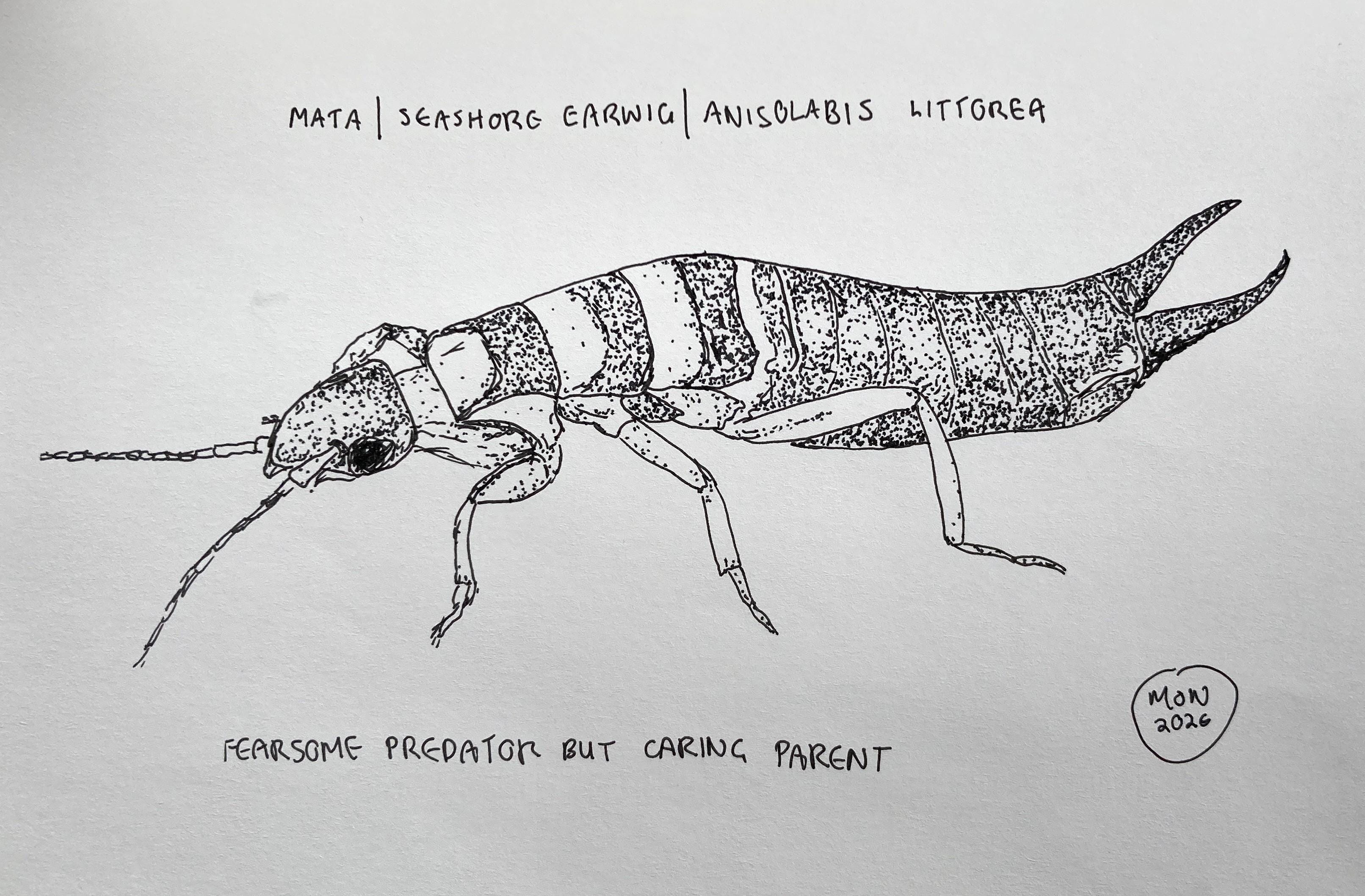
Mata | seashore earwig | Anisolabis littorea
The earwigs that we encounter in New Zealand gardens were introduced from Europe many years ago. They were first recorded in 1949, but could have been present for decades before that. However, New Zealand does have a small number of native earwig species, almost all found nowhere else. Of these, the mata is the most common.
The mata is not our largest earwig, that distinction belongs to a species found only on Manawatāwhi/ the Three Kings Islands. However, it is still a large earwig, up to 3.5 centimetres long. It lives on or near the seashore, often under driftwood or seaweed, and is flightless. Like most other earwigs, it’s a fierce predator but a caring parent. Females clean and guard the eggs, and bring food for their young.
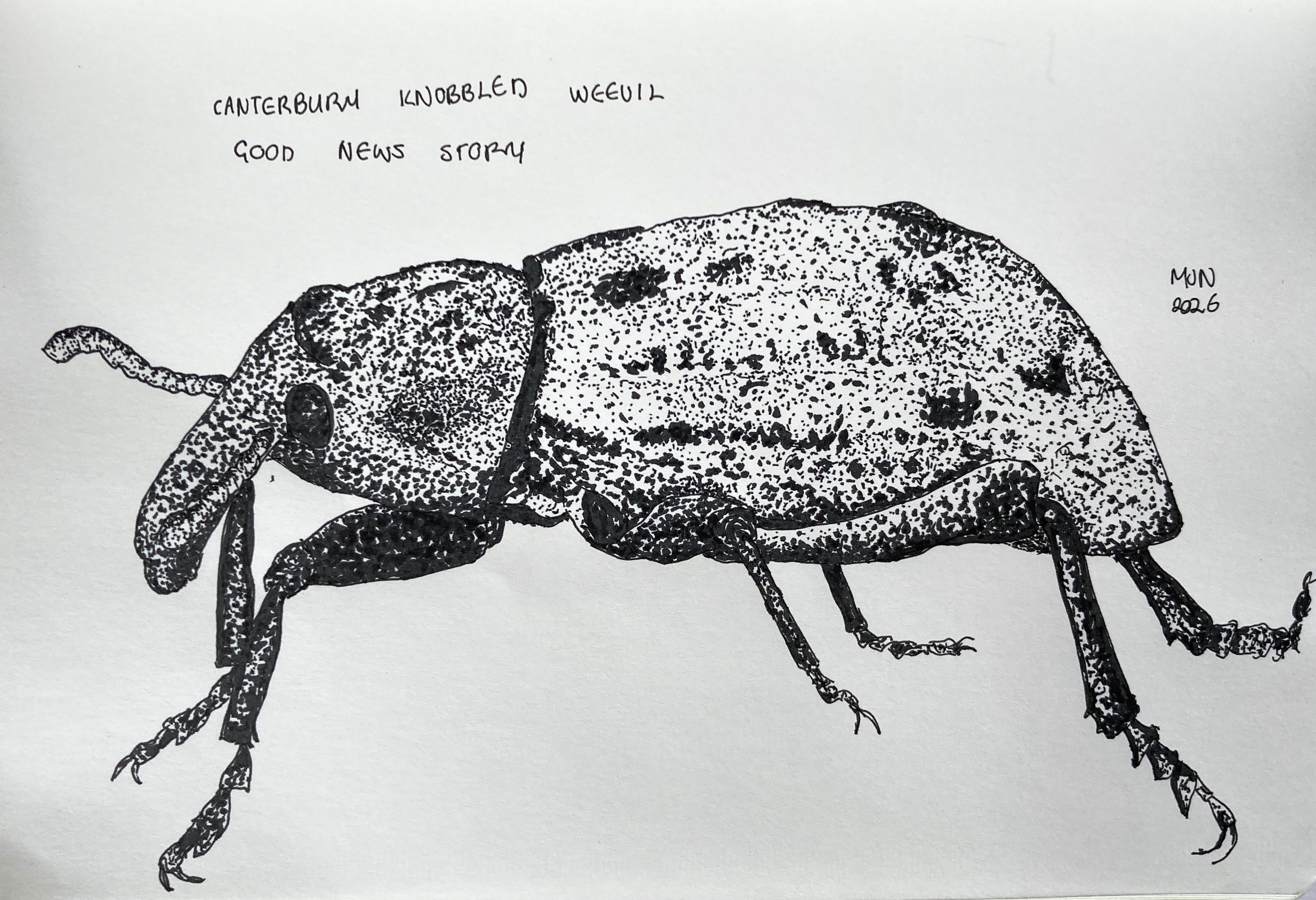
The body of the mata is dark brown and glossy, which gave me some trouble when I came to draw it. I’ve found that the felt pens I usually use are great for insects with highly textured bodies, such as the Canterbury knobbled weevil (see below), but not so good for insects with glossy bodies. I decided to try a drawing using only a very fine black ink pen – you can see the result below. Since I was enjoying this style, I’ve done a whole series of line drawings.
Why you should vote for the mata:
Fierce predator, caring parent
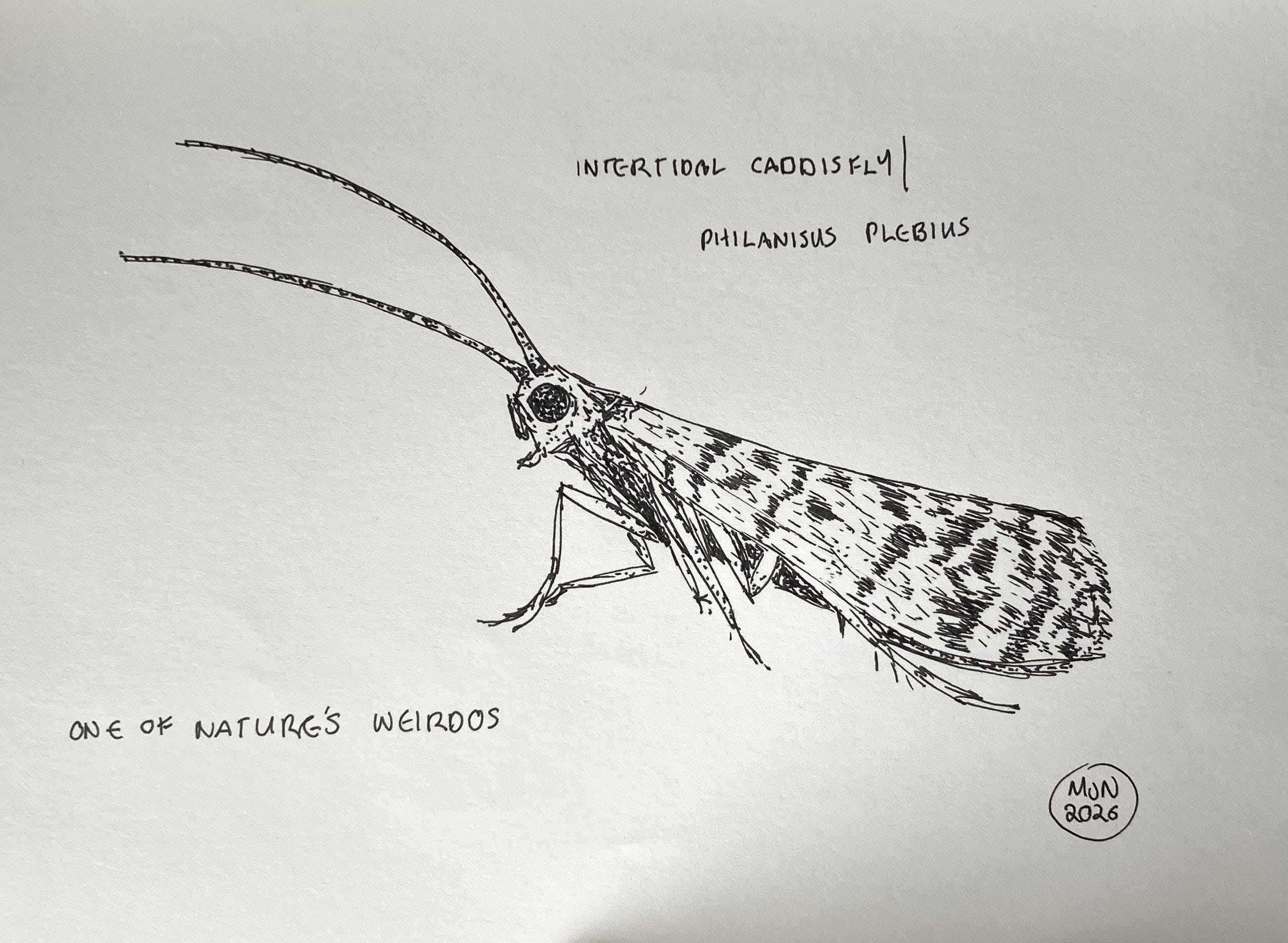
Intertidal caddisfly | Philanisus plebeius
On land, insects are everywhere. Open a window at night, and moths will fly in. Leave food uncovered, and the flies will come. Move an outdoor plant pot, at least in Wellington, and you’ll see a native cockroach scuttling away. Leave a container of water outside, and mosquito larvae will soon appear. Step anywhere off the tarmac in Australia, and you risk a trail of ants running up your leg.
Although it’s less obvious, they are in ponds, lakes, rivers and streams as well. But there’s one place you don’t see many insects – the sea. Very few tolerate salt water.
One of the few that does is the intertidal caddisfly. On the one hand, it’s a typical caddisfly. The young caddisflies live in the water and build themselves a well-camouflaged home from fragments of materials they find in its environment. Adults emerge from the water and live on land. On the other hand, though, the young caddisflies live in seawater, and cannot survive in fresh water. Things get weirder, though. The eggs are actually laid inside the bodies of cushion stars, a kind of starfish. There, they don’t cause obvious harm, and when the eggs hatch the young caddisflies quietly leave and go on to live a normal caddisfly life, aside from being in seawater.
Why you should vote for the intertidal caddisfly:
One of nature’s weirdos.
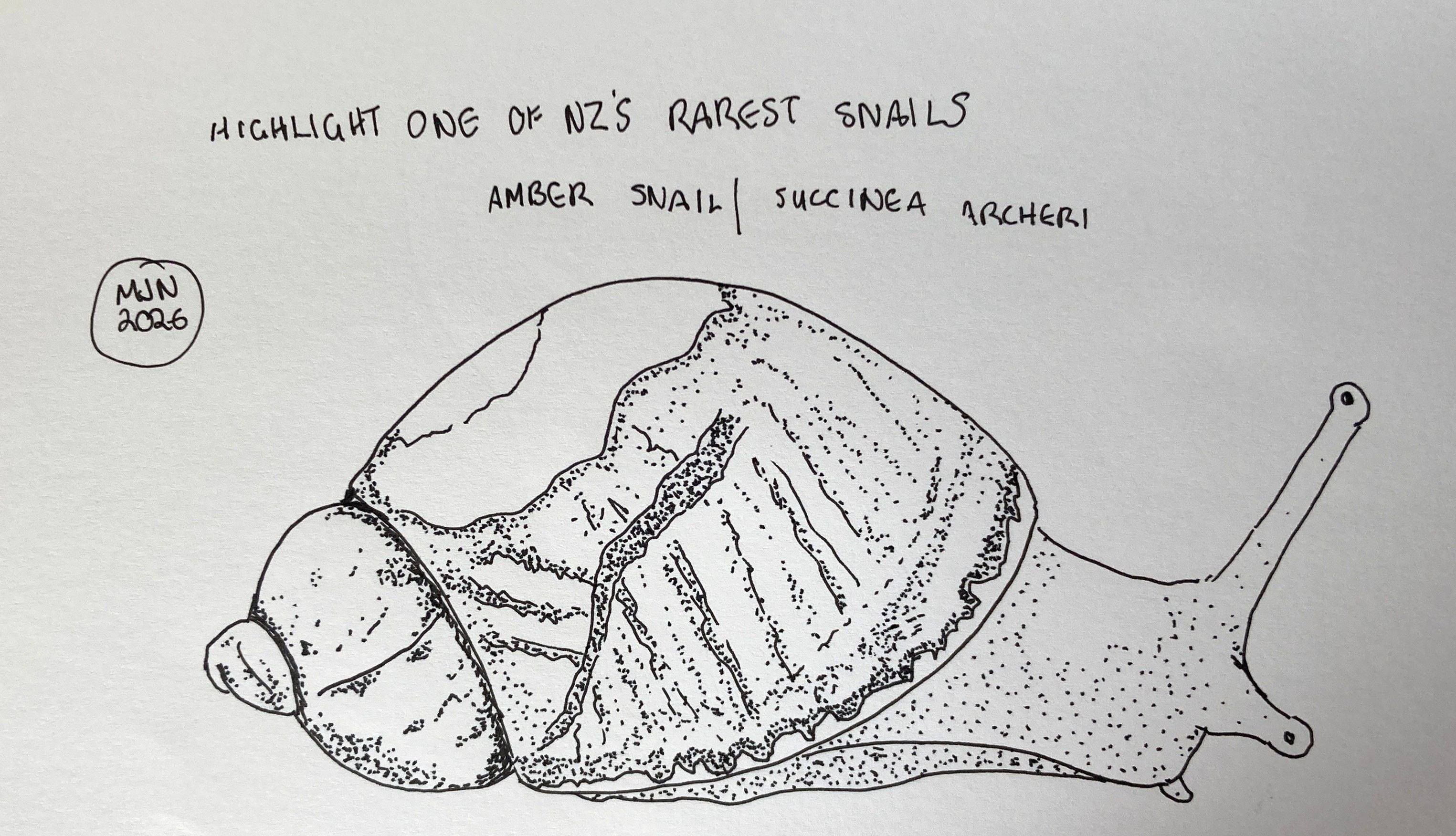
Amber snail | Succinea archeyi
The amber snail is yet another “bug” to make its home on the seashore. It was once widespread, but is now found only in very limited parts of Northland and the Coromandel Peninsula. Its usual habitat is sand dunes, among spinifex grasses and other native dune species. Since these environments are heavily modified in most areas, this snail is now in serious trouble.
New Zealand has some stunning giant snails, some with shells nearly 10 centimetres across. The amber snail, however, is a delicate beauty, with a translucent shell not much larger than a centimetre in size. It deserves its moment in the spotlight.
Why you should vote for the amber snail:
One of our rarest snails deserves more attention
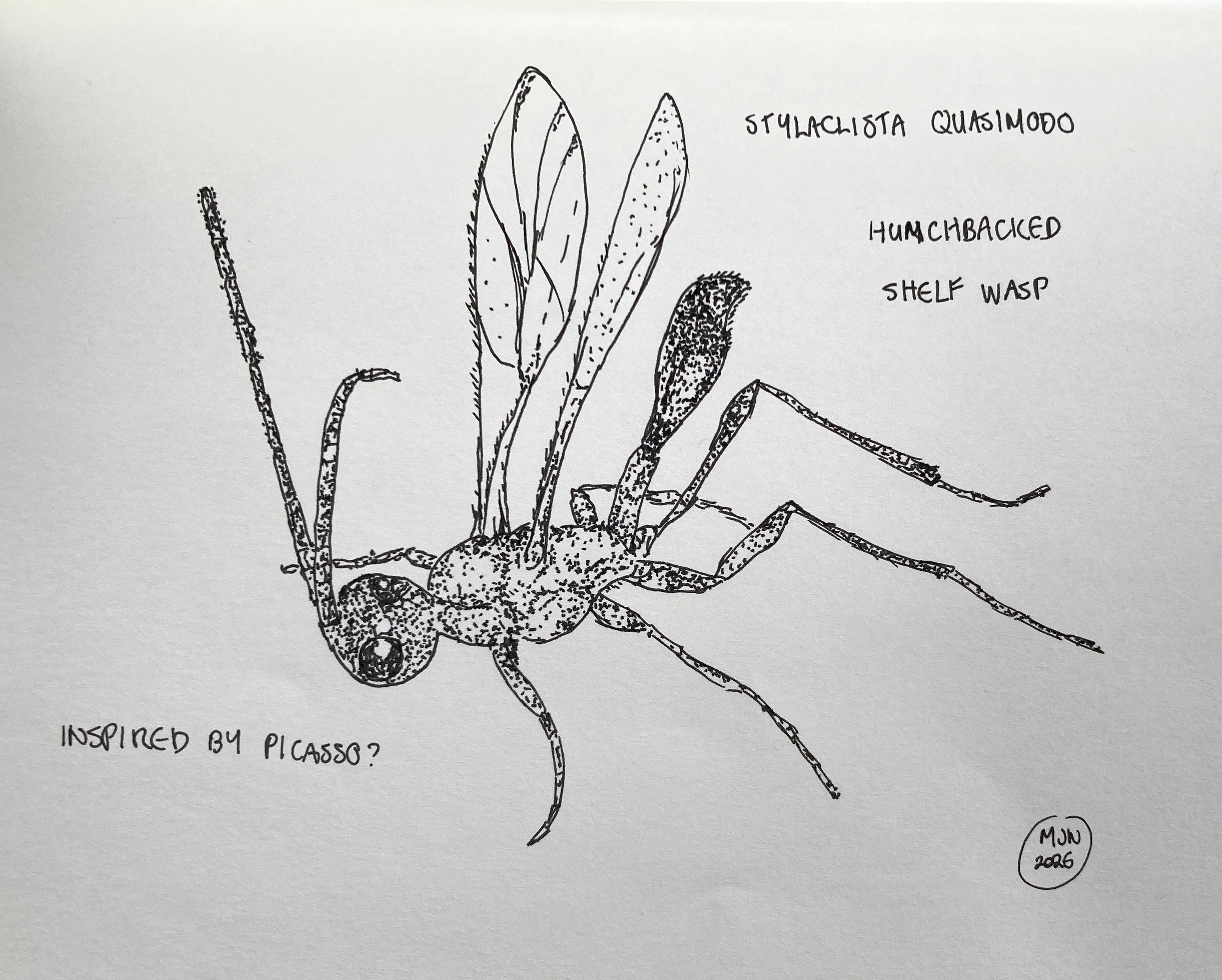
Hunchbacked shelf wasp | Stylaclista quasimodo
Among the insect group which includes ants, wasps and bees, the species we know best are social, living in large colonies. However, the vast majority of that group are solitary parasitoids, that is, they spend their entire juvenile stage inside another animal, emerging and killing their host when they are mature. The hunchbacked shelf wasp is one such species. Its host isn’t known, but is probably a kind of fly known as a gall midge, based on the host species of its relatives.
Parasitic wasps are often host-specific, meaning that each wasp species depends on a single host species, or a few closely related hosts. This makes them useful as biological control agents. The key to safe biological control is using agents which are proven to be host specific, as opposed to the disasters caused by the introductions of animals such as stoats, cane toads and the rosy wolf snail, all of which eat a wide range of prey.
The hunchbacked shelf wasp is apparently named for the shape of the female wasp’s body. However, I think the one I’ve drawn is a male. There are few close-up photos of the hunchbacked shelf wasp available, and most of the ones I saw seemed to show the wasps with their eyes and some of their body parts in rather odd positions, almost as if they were drawn by Picasso. I tried to draw what I saw, so I’m sorry if it looks a little odd.
Why you should vote for the hunchbacked shelf wasp:
Looks as if it inspired Picasso
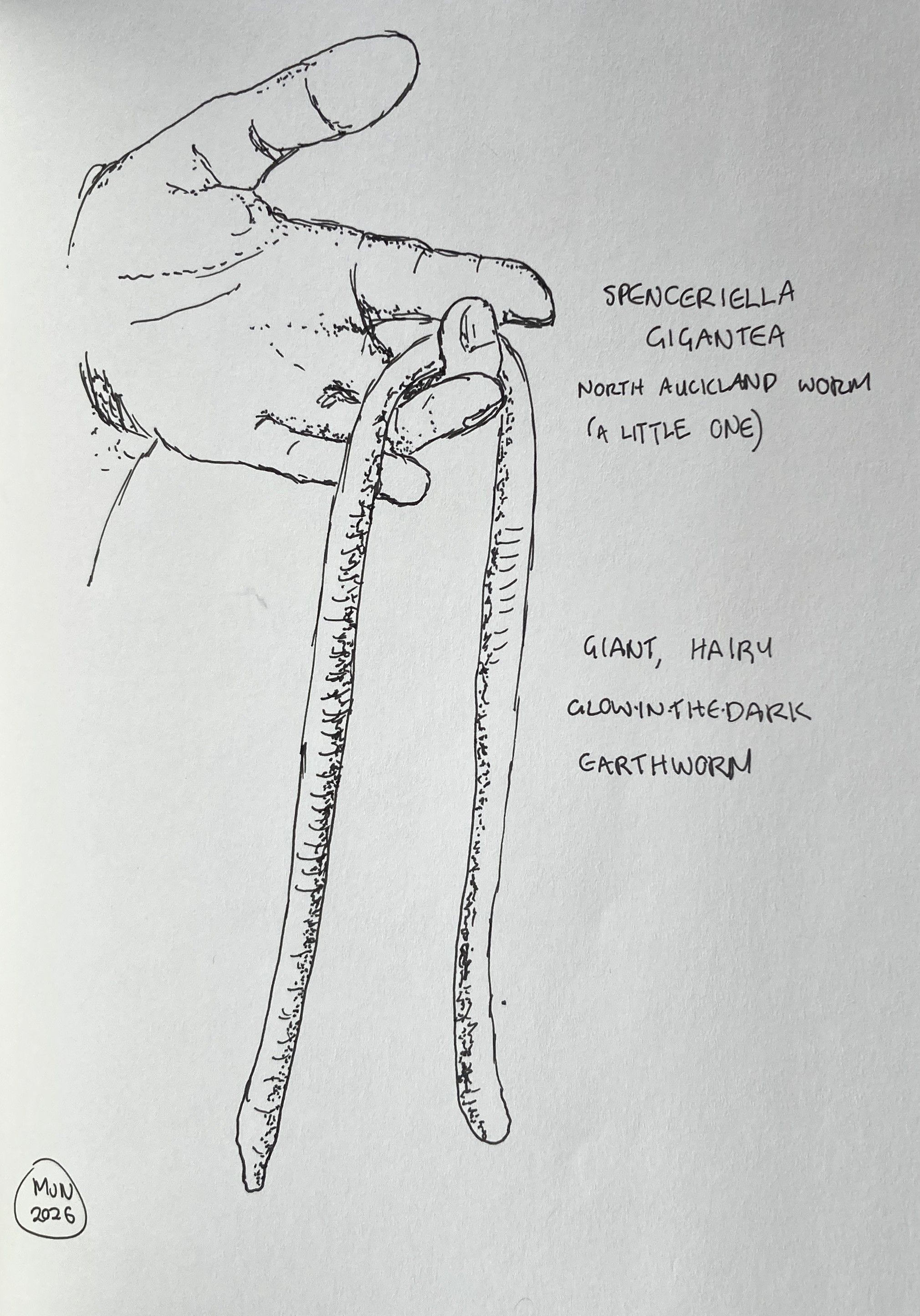
North Auckland worm | Spenceriella gigantea
Like the earwigs, the earthworms we most often encounter in gardens are introduced species. However, New Zealand has a number of native earthworms, some of which are huge. The North Auckland worm can be over a metre in length, but it lives in the lower part of the soil, known as the subsoil, so is seldom encountered. Its burrows can be 2 centimetres wide and the deepest ever discovered was 3.5 metres deep.
New Zealand has other earthworms which are large – I occasionally encounter them if I dig particularly deep in my garden. However, the size of the North Auckland worm puts it up with the world’s largest species, such as the giant Gippsland earthworm in Australia.
None of the photos I’ve seen show this, but apparently the North Auckland worm is unusually hairy and glows in the dark.
Why you should vote for the North Auckland worm:
Do I really need to say? It’s a giant hairy worm which glows in the dark!
Canterbury knobbled weevil | Hadramphus tuberculatus
I’ve previously shared a drawing of the Canterbury knobbled weevil, as I wrote about it in an article on invertebrate extinction. It’s one of the good news stories, rediscovered in 2004 after being believed extinct for decades. It is one of the weevils which have a taste for a group of plants known as speargrass. Despite the name, these aren’t grasses but carrots. They do, however, have vicious spine-tipped leaves, so half of their name is accurate.
Although weevils have a bad name for infesting flour and other stored products, New Zealand has some delightful weevils and this is one of them.
Why you should vote for the Canterbury knobbled weevil:
We need more good news stories in conservation
If you haven’t voted for your favourite bugs yet, now’s the time! I’ve described and drawn all of them, so here is the link to vote.
I really like these B&W sketches. Are you using stippled paper to get that effect?
Fantastic read and the illustrations are superb. That detail about the hunchbacked shelf wasp being host-specific is cruical context people miss when talking about biological control. I remember working on a project where we evaluated control agents, and the differece between specific parasitoids versus generalist predators was night and day in terms of ecosystem impact. The Picasso comparison made me laugh though, sometimes nature just does weird stuff and we try to make sense of it.