

A mountain fragment
The indifferent Nilgiri tahr of Eravikulam National Park (4 minute read)

I have an idea from New Zealand of what national parks are like. My favourite is the Kahurangi National Park, more than 5000 square kilometres of mountainous wilderness in the north-west of the South Island. I’ve seen only a tiny part of it, and most of it I’m sure I will never see, since it includes some of New Zealand’s most remote, inaccessible and treacherous terrain. I’m still happy, though, to know that it’s there and protected.
Other national parks are more hospitable. The coastal track of the Abel Tasman National Park is so well-graded that I walked almost the entire distance in a pair of knockoff Crocs. The huts have flush toilets. Water taxis shuttle up and down the coast, so there’s no need to tackle more than you want to. In the Tongariro National Park, it’s possible to drive most of the way up Mt Ruapehu. When the ski field is operating, you can even buy a hot meal 1600 metres up an active volcano.
One thing I’ve never encountered in New Zealand, though, is a queue to enter. So when I visited Eravikulam National Park, in the mountains inland from Kochi in Kerala, I was in for a shock. The park is close to Munnar, a hill town among tea plantations which is one of the most popular tourist destinations in the state. A walk in the park is one of the most popular activities, which means that every morning hundreds of people would line up to buy entry tickets and wander up and down the short frament of mountain road which is open for tourists. These days, there is an online booking system, but I was there in 2014, and I just stood in a very long queue.
To someone used to tramping tracks and the solitude of the New Zealand forest, it didn’t feel much like being in a national park. But I was still in the mountains. I was still in a place which was protected for the sake of the animals and plants which had always lived there. I could still enjoy the wild and inhospitable landscape, the rocky crags and sheer drops, the sweeps of open grassland and the moody skies, even if I was walking on a sealed road.


One of the main reasons the Eravikulam National Park exists is to protect the endangered Nilgiri tahr. It looks like a mountain goat, and the name suggests it’s a relative of the Himalayan tahr, which has been introduced to New Zealand’s South Island (another invasive species I want to write about one day). It has been only in the last 20 years that scientists have realised that the two species are only distantly related, with the Himalayan tahr more closely related to goats and the Nilgiri tahr closer to sheep.
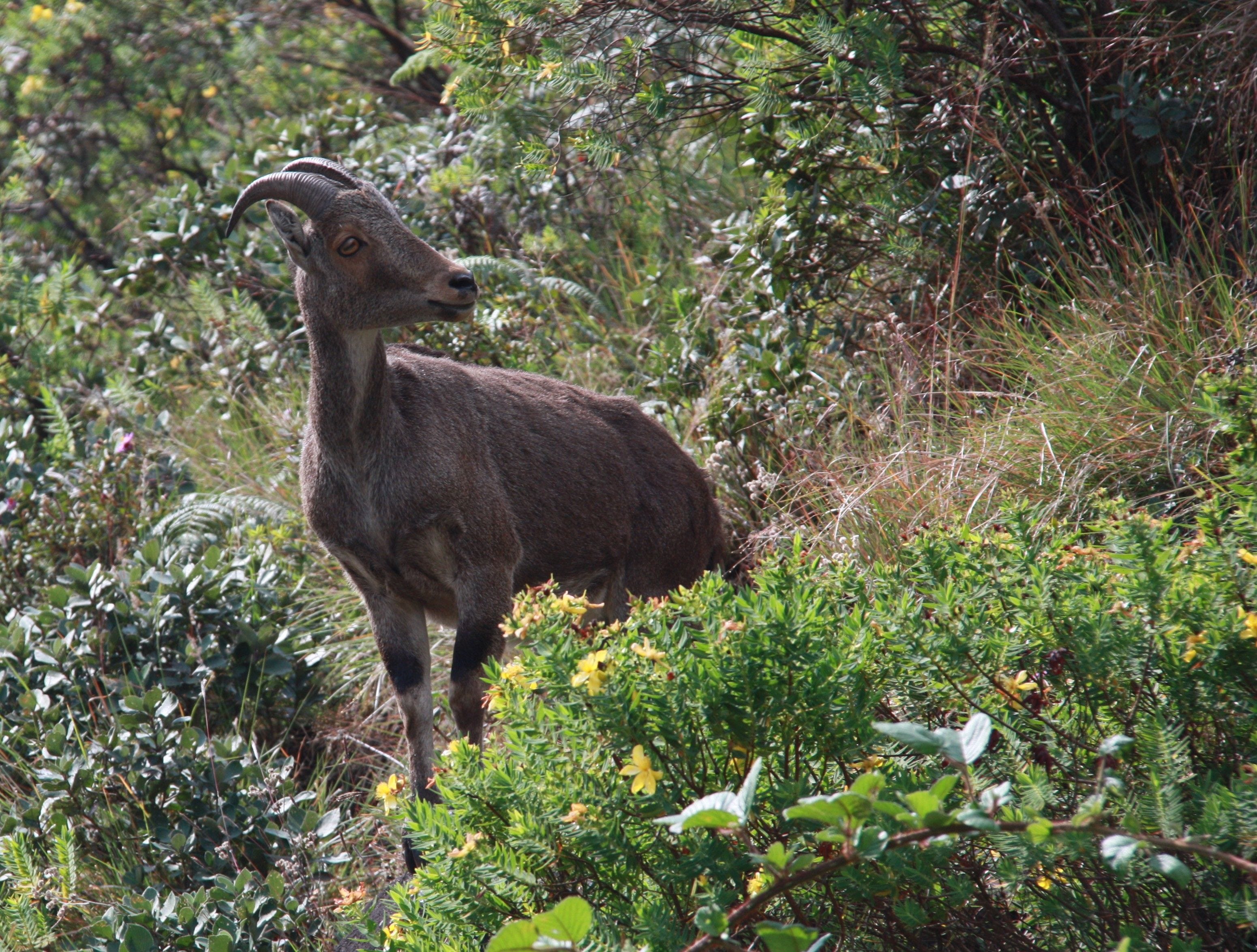
The Nilgiri tahr is native to grasslands in the mountainous area along the border between Kerala and Tamil Nadu. The landscape is a mosaic of grassland, forest, tea plantations and agricultural land, much of it heavily modified by human use. But the Nilgiri tahr is almost exclusively a grazer, so it survives only in grassland. It was once widespread, but its habitat is now highly fragmented, as is the population of Nilgiri tahr. There are only 2000-3000 left. Eravikulam holds the largest population, around 700 animals, with the next largest population in the Anamalai Tiger Reserve to the north in Tamil Nadu.
I’m sure that some of the Nilgiri tahr in Eravikulam act like wild animals, but the ones living near the section of road accessible to tourists could not be more indifferent to the presence of humans. It seems as if people follow the rules and don’t feed them, because they show no inclination to approach, or even look at, the hundreds who pass by. But nor do they make any attempt at avoidance. They just don’t seem to care.
My visit to the Eravikulam National Park was brief, only a couple of hours at most, and I’m sorry to say that this article is brief as well. I’ve spent almost all of this week (including the Matariki public holiday), writing a report which was due this week for a contract I’m doing. I’d love to write more about the Nilgiri tahr, the native plants and the stunning landscapes, but I’ll leave you instead with some of my photographs.


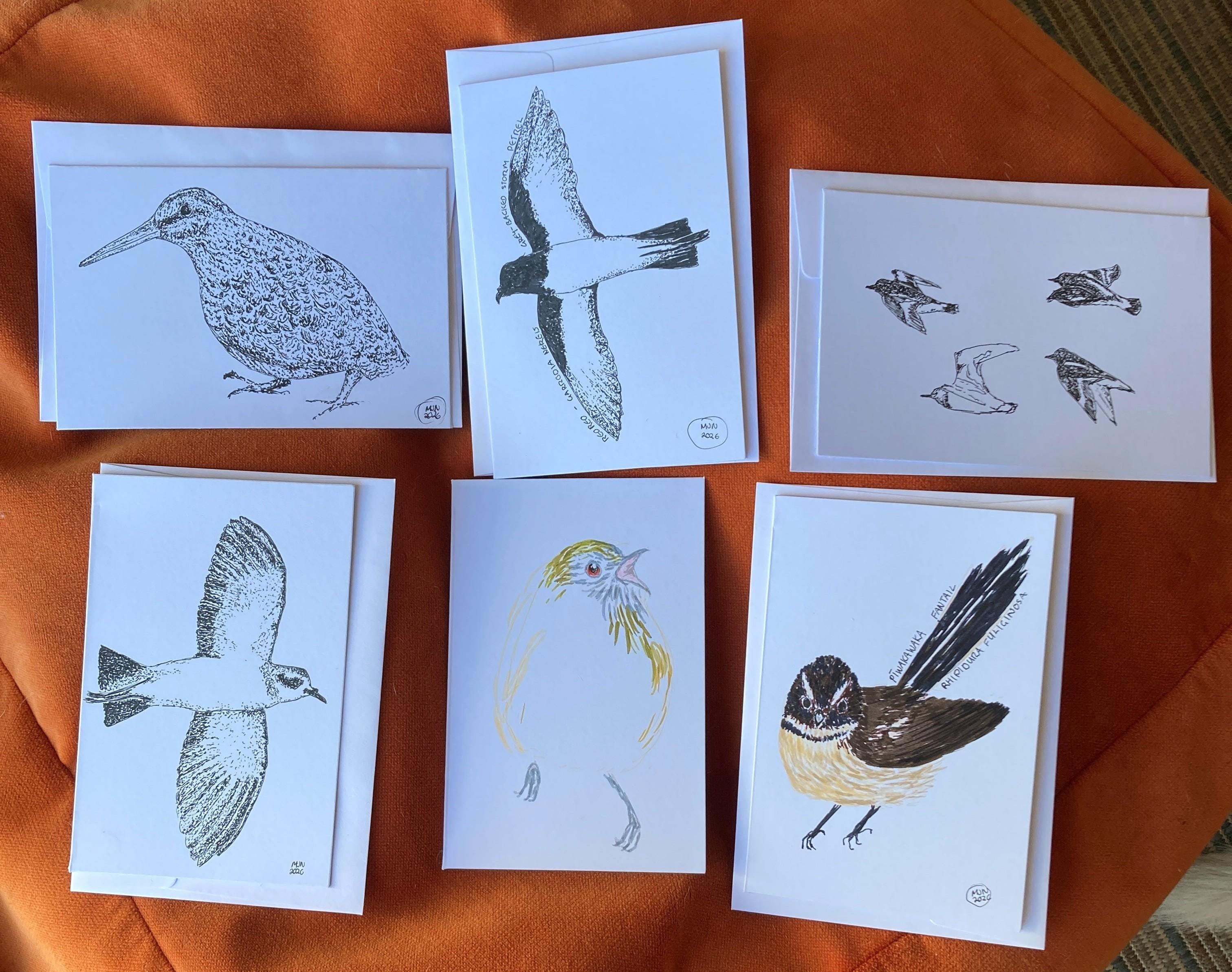
I also have an update for my paying subscribers. I’ve been working on notecards for two more prize draws: a set of seabirds, drawn only in black ink, and a coloured set of small birds with big attitudes. I haven’t yet finished the sets, but here is a preview. The bird in progress is a korimako.
In Aotearoa the tahr is a pest and a threat to rare alpine plants. But this government is set to protect them, so rich, white, gun toting men can hunt them at leisure.
wow, what a beautiful place! Love the photos as well ❤️