

Awakening a monster
Is this the world’s most unlikely invasive species? (12 minute read)

Even from the far side of the river, I can see that the animals are huge, but they don’t seem threatening. Most are asleep and they look so relaxed they appear almost boneless. Lying on the sand, they look like large, uncooked sausages which have been dropped from a height and have flattened slightly. Some lie on their sides, others are belly-flopped with their stumpy legs sticking out sideways from underneath folds of loose skin. One lies, eyes closed, with its head and shoulders on the sand and the rest of its body in the river. Despite the river’s swift current, it’s not budging. It must weigh well over a tonne.
Although they appear comical, I know that I’m looking at dangerous animals. There are hints of their unpredictable character in some of their African names. On the one hand, their Zulu name, imvubu, is also used to refer to someone who is lazy. On the other hand, their Tswana name, kubu, refers to awakening and rebelliousness. One ominous translation of the name is sudden awakening. The slothful animals I can see cannot be relied on to stay asleep.
The English name, hippopotamus, simply means water horse, making them sound much more benign. But while the heaviest of heavy horses, the Shire, usually weighs from 860-1000 kilos, a hippo can weigh twice that, or even more. Their colossal size, I realise, is one of the reasons they look so relaxed. They don’t need to sniff the air for the scent of lions or watch for ripples in the water which might alert them to the presence of a crocodile. In fact there are a few Nile crocodiles on the riverbank, and the hippos aren’t paying the slightest attention to the comparatively puny reptiles. As far as I can tell, there aren’t any predators which can take on an adult hippo, apart from a human with a high-powered rifle.
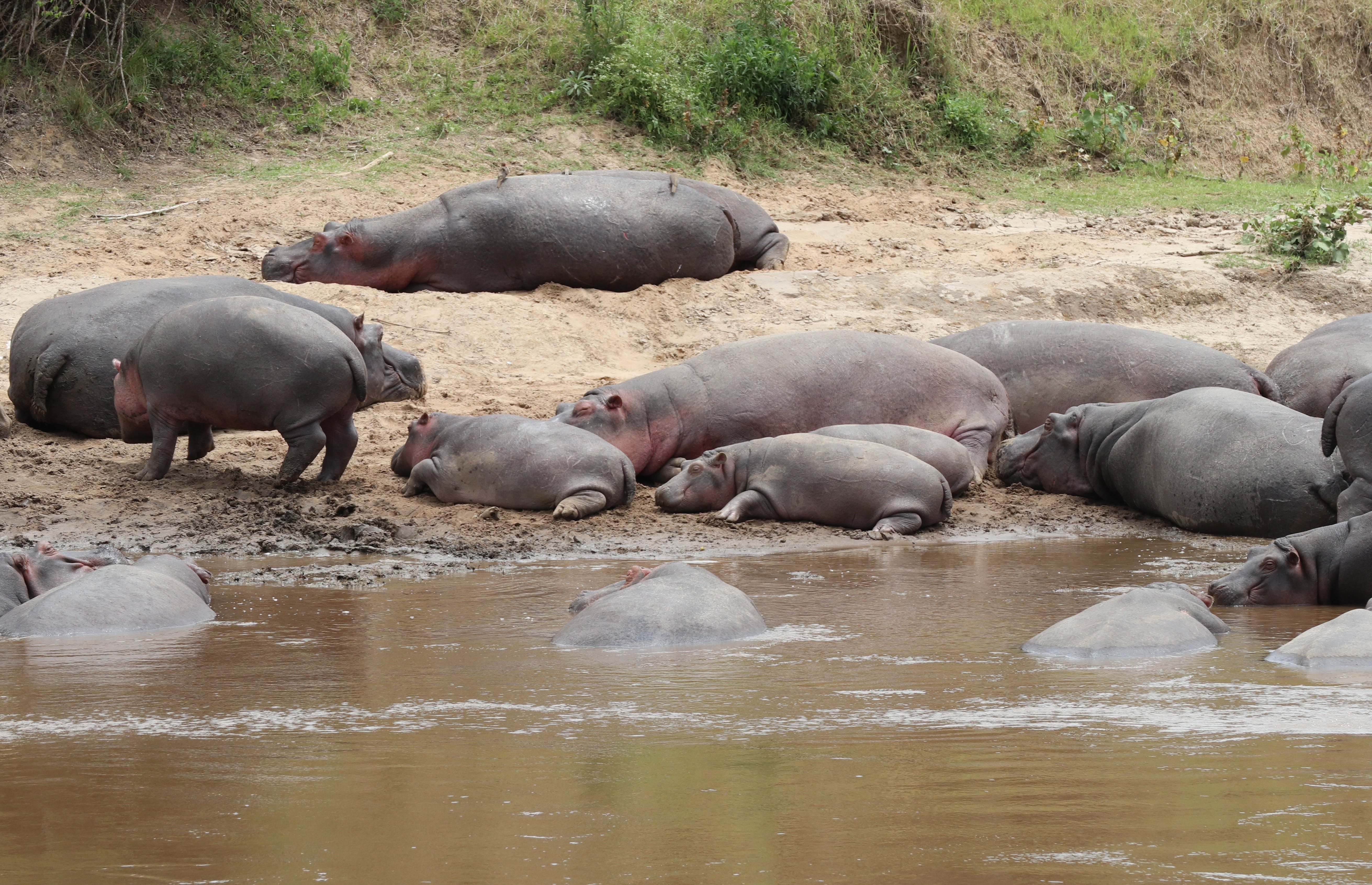
Their size and unpredictability aren’t the only reasons hippos can be dangerous. Their mouths are massive. A hippo’s jawbone is 40-60 cm long and 30-50 cm wide, and it can open its mouth wider than almost any other animal. Its incisor and canine teeth narrow to sharp points, and its bite force is nearly three times that of a lion’s. A human is more likely to survive being attacked by a grizzly bear or a shark than a hippo. One source suggests that a hippo attack is even more likely to be fatal than an attack by a lion, buffalo or elephant. Another source suggests that elephants and crocodiles are more likely to cause fatal injuries, but that’s cold comfort, because the chances of dying are still greater than 50%. Survivors suffer devastating injuries and often require limb amputations. A hippo isn’t an animal you want to experience up close.
But how often do such attacks occur? The often-cited statistic that more people are killed by hippos than any other large African animal is not supported by evidence. In Zimbabwe, most deaths are caused by elephants and crocodiles. In Mozambique, crocodiles killed more people than all other large animals combined. Tourists in South Africa, on the other hand, are more likely to be killed by lions, usually because they’ve decided to leave their vehicle and walk up to them. It’s difficult to find estimates of total numbers, but a few specific examples give an indication. In Zimbabwe from 2016-2022 around 2-4 people a year were killed by hippos, in comparison to 20-40 killed by crocodiles. Over a 2 year period in Mozambique, 12 people were killed by hippos in comparison to 136 by crocodiles. Over a period of more than 70 years in Uganda, there were 30 deaths attributed to hippos, 46 to elephants and 636 to lions.
None of this diminishes the horrific, lasting impact of such an attack. In risk terms, the likelihood of an attack might be low, but the impact is certainly high. As I walked along the bank of the Mara River, as part of my visit to Kenya in 2023, I was reassured by the presence of armed guides. I’m pretty sure they wouldn’t offer this walk to dozens of tourists every day if the guides were likely to use those guns, but it would have been unwise to forgo the precautions.
Many of the large animals which occasionally kill humans are predators, species such as crocodiles, lions, tigers, leopards, cougars, sharks and polar bears. It’s unsurprising that they might view humans as potential prey. While other bears are omnivorous, attacks by some species, such as black bears, are also often predatory. But elephants and hippos are both herbivores. Hippos mostly eat grass, around 60 kg per night, since they don’t feed during the day. They aren’t going to snack on a human.
Why, then, do they attack and kill people? The simple answer to this question is that they are large, powerful animals not used to fleeing from possible threats. A hostile interaction between an unarmed human and a defensive hippo is unlikely to turn out well for the human. Many attacks are described as accidental, where someone unexpectedly finds themselves too close to a hippo.
The complex answer to this question considers why humans end up too close to hippos. Most of the large animals which sometimes kill people are concentrated in reserves, and it’s those on the margins of the reserves which bear the brunt of their impacts. Hippos are different because aren’t found only in or near reserves. They can be in any waterway or wetland.
Problems arise in or near waterways because people and livestock need access to water. As well as attacking people in or near the water, they attack small boats and can become entangled with fishing nets. They visit farms at night and eat crops too. The farms most affected are those near the access points hippos use to move between the river and the land. In areas where agriculture is expanding and wetlands are drained for farming, more people are coming into conflict with hippos.
While hippos do cause problems for people, we cause far more harm to hippos. In Mozambique, over the period in which 12 people were killed by hippos, 60 hippos were killed by people either because they were eating crops or considered a threat to people. Humans are harming hippos in other ways to, from poaching to draining wetlands and polluting waterways. They are classed as vulnerable on the global list of endangered species and the total population is thought to be declining at a rate of 6-8% per year. However, local researchers have pointed out that there is limited data for many countries and that the situation for hippos may be worse than the classification suggests.
Although living with hippos can be difficult, people have nuanced views of them. They are integrated into local languages in many different ways, such as in the Batswanan word for waking up, which literally means to do like a hippo. While they are recognised as dangerous, they are also sometimes revered in local religions. One culture had a prohibition against killing hippos, although if one animal frequently killed people, they would employ someone from another culture to kill it.
I could write much more about the challenges people face from living close to dangerous wildlife, but that’s not my focus today. I wanted to explain about the dangers of hippos and how difficult they can be to live near because it proves a point about invasive species. Sometimes a species which is moved from one region to another behaves in an unexpected way. We can’t predict everything. But sometimes what happens is entirely predictable. We have known that hippos are dangerous for as long as we have existed as a species. We’ve been trying to stay out of their way since the dawn of humanity.
So how on earth did hippos become an invasive species in Colombia?
The bizarre tale begins in 1981, when an obscenely wealthy drug trafficker bought a male and three females from a zoo in the USA to keep on his private estate in Colombia. When he was killed in 1993, most of the exotic animals in his extensive collection were removed from the estate and sent to zoos, but the hippos were difficult to move, so they were simply left in their pond.
For some years, both the hippos and the estate were abandoned, but in 2006 the estate was developed into a theme park with a pink hippo as its mascot. By that time, there were 16 hippos on the estate, and they were part of the attraction. But at some point, possibly even before that time, the hippos began moving beyond the boundaries of the estate and into the Magdalena River. By 2009, a few hippos were seen 90 km further down the river, prompting concern from locals and officials that a wild population of such a large, dangerous animal was a threat.
There was another concern as well. In Africa, hippos have significant impacts on the rivers and wetlands where they live, particularly on the movement of nutrients. By consuming large quantities of vegetation and depositing most of their waste in the water, they add nutrients to waterways. The high nutrient levels support large populations of certain species, such as the African mud catfish. The environmental conditions hippos create alter fish behaviour in ways that make the fish more easily caught by birds, which moves nutrients from the water to the land.
These patterns have been part of African waterways for as long as hippos have been hippos. But there have never been hippos in Colombia. There was once a large, semiaquatic mammal in South America which possibly had similar effects on the environment to hippos, but that’s really speculation. It became extinct more than 11,000 years ago and a lot has changed since then. It’s difficult to predict the precise impacts that hippos would have in Colombia, but there can be no doubt that if the hippo population increased, the effects would be substantial.
At this point in 2009, there were clearly diverging views about the hippos. On the one hand, they were valued as a tourist attraction and because they are fascinating and remarkable animals. On the other hand, they were well-known to be dangerous to people and were likely to cause major changes in river environments.
Despite the different opinions, it may have been possible to come to some agreement about the best way to manage hippos at that point. However, what happened next would change everything. A group of soldiers was sent to hunt the hippos which had spread from the estate. They managed to kill one, and posed for a photograph with the dead animal. When the photograph was published, it prompted widespread public outrage. The government was taken to court by animal rights activists, and the court banned the killing of any more hippos.
Hippos were still recognised as a potential threat, so attempts were made to sterilise some of the hippos. This went about as well as you’d expect. It’s extremely difficult to safely tranquilise a thick-skinned animal which weighs a couple of tonnes, is aggressive towards people and which spends most of the day in water. A few were captured and taken to zoos, but that’s equally difficult, and most zoos are picky about the genetic origins of the animals they take, to avoid inbreeding.
So, the hippos kept breeding and spreading. They became a subject for academic theorising on the different visions of nature which they signify, the similarities between the photo of the dead hippo and a photo of the dead drug trafficker, and the potential environmental benefits of hippos. In particular, some researchers proposed that hippos were “rewilding” the environment by replacing species lost more than 10,000 of years ago.
There are situations where there’s a compelling case for introducing a non-native species very similar to an extinct species to achieve a particular environmental outcome. The one I’m personally familiar with is the introduction of giant tortoises from Aldabra Atoll to islands off the Mauritian coast. The tortoises have helped keep invasive grasses under control and allowed rare native plants to survive. But they were introduced slowly and carefully, in response to an extinction which happened within the last few hundred years. They were confined to small areas and monitored until it was clear that they were going to do more good than harm.
There’s a vast difference between introducing a close relative of a recently-extinct animal in a carefully controlled way and letting a drug lord’s escaped pets run wild, especially when they have such profound impacts where they are native. However, the Colombian authorities have had little choice but to wait and see.
By 2018, scientists estimated that there were around 60 hippos, up to half of which were living beyond the estate. There were predictions that by 2050 there could be 400-800 hippos in Colombia. By 2022, estimates suggested that there were 200 hippos and that by 2035 there could be over 1000. A 2020 study noted that there had been no comprehensive analysis of the potential impacts, whether positive or negative, and as far as I can tell, that still hasn’t been done.
The most recent news is that Colombian authorities recently announced that they are planning to cull some of the hippos. The plan has provoked a strong backlash, and it’s unclear whether there will be further legal challenges. Colombians are still divided in their views about the hippos.
While I have little sympathy for the possible rewilding argument, I do have sympathy for those troubled by the proposed cull. I hate to see the needless killing of an endangered species. We have caused hippos much more harm than they have caused us. When hippos are minding their own business sleeping on a riverbank or wallowing in the mud, they are so comical it’s hard to see them as dangerous. When there are only a few of them, it’s hard to imagine the impact which hundreds, or even thousands might have. But it’s not hard to predict what’s likely to happen in Colombia if they aren’t controlled. It’s not going to end well, for either people or the hippos.
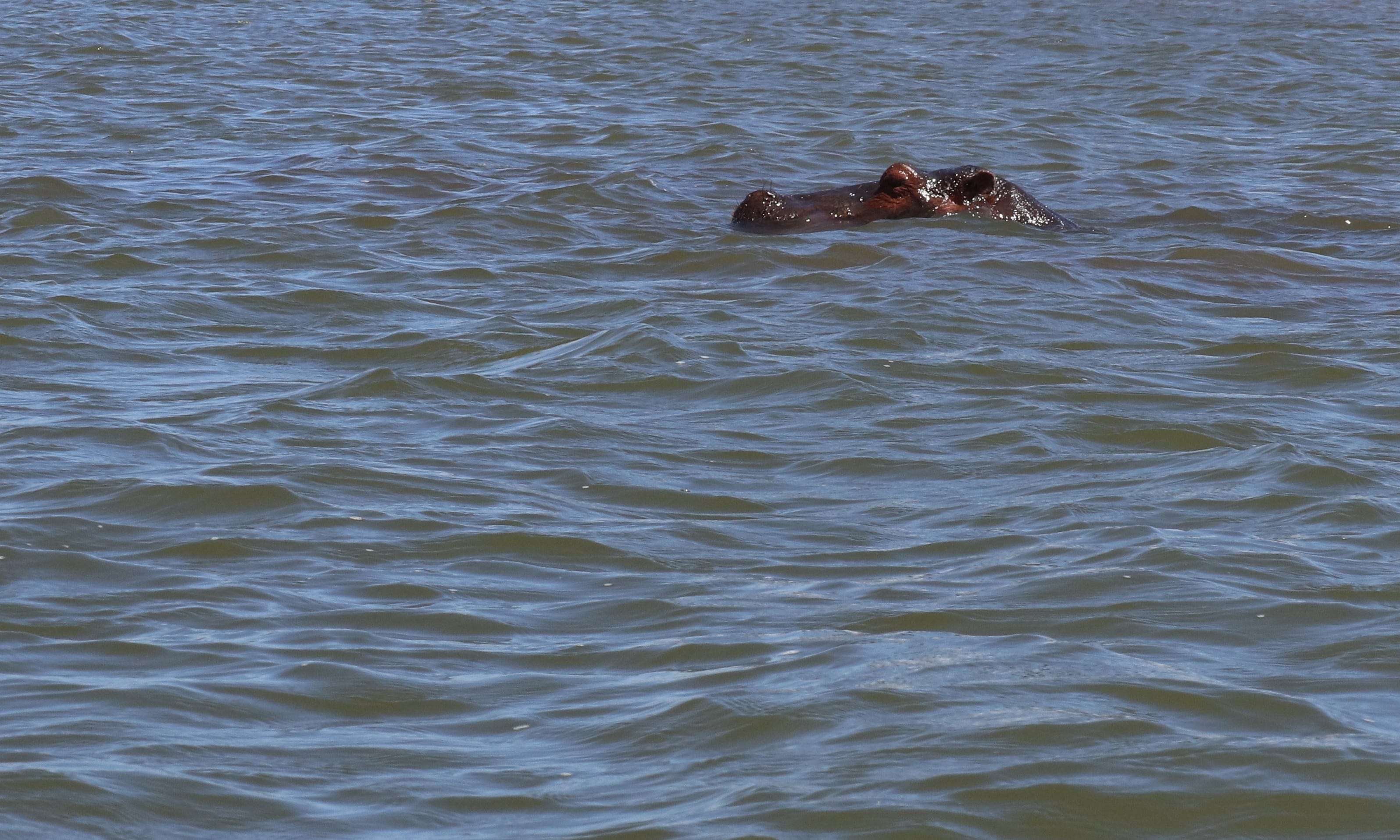
Having spent time in the Okavango of Botswana I had the opportunity to observe (luckily not too closely) hippos and learn from locals how to avoid conflict (meaning they make the rules, we follow them). It was an unusually dry season so there were limited places the hippos could go so we had to adjust our time on the water to suit them.
I have no problem with culls of the drug lord hippos. I know it's not easy to do but the damage they are causing will only continue to ramp up if they're not removed. I only feel sorry for the people charged with doing it. Even when you know it's right it never gets easy.
🤔 Fascinating! I have seen the odd news item about these particular Hippos & how they came to be roaming somewhere so far from "home" but their possible ecological impact is not usually the focus ... In general I think the people opposed to "culling" for good & obvious purposes (the culling I mean!) should be responsible for coming up with the solution 🤷 If they want the animals to be relocated instead, then they need to form an organisation to find homes & fundraise for the transport etc to uplift them & deliver them 🙄 It's a cop-out to tell the authorities they can't do something for the public good without coming up with a suitable alternative IMHO. Reminds me of people who don't want control of wee "cute" hedgehogs & feral cats decimating our indigenous species without addressing the fact of the harm they cause 🥹 Humans have a lot to answer for (in more ways than one!)