

Christmas critters
Something a little different for Christmas (4 minute read)

It’s coming to the end of another difficult year for many people. While I hope that the season of Christmas, New Year, and many other festivals will be a time when the struggles ease and life seems brighter, I know that it’s often the opposite. For many of us, this is a time when losses and absences are felt more intensely. Often, too, the pain of these losses and absences is unspoken and unnoticed. So, I can’t send out a festive holiday message without first acknowledging those for whom this time is difficult, or at best ambiguous. There’s nothing wrong with feeling something which isn’t the expected joy or good cheer. It’s a hard time and I’m thinking of you.
I also can’t ignore the state of the world. It seems as though there is so much that is getting worse – climate change, conflict, inequality, human rights. I know that there are bright spots. I know that some people are doing the most wonderful, brilliant and kind things. This is where I try to keep my attention. But I also recognise that these bright spots sometimes seem like a few raindrops in a parched desert.
This year, I’ve been finding joy in some unexpected places. Earlier this year, I took part in some events for the City Nature Challenge on iNaturalist. As a result, I began noticing things I hadn’t been paying attention to. I became entranced by the subtle, intricate beauty of moths. I began spotting leaf spots and other native diseases which infect our native plants without really doing any harm. I observed the many unlikely places which provide a home for lichens, from power poles to footpaths and even on a car I saw on my trip to Taranaki with Donna earlier this year.
I’ve also found joy in the process of practising a skill and seeing myself improve. Drawing has become my way of relaxing and unwinding, of absorbing my mind in something which doesn’t involve words. I’ve tried to draw several times a week, and can certainly see my progress.
So, as my little gift to you, I’m sharing some Christmas-themed drawings. But I’ll probably need to explain how they relate to Christmas.
Firstly, I’ve drawn pōhutukawa, which needs no explanation for New Zealanders. For those overseas, these lovely trees are smothered with red blossoms during December, and so are known as New Zealand’s Christmas tree. I’ve also drawn a couple of related plants, the southern rātā, which is a large tree and the carmine rātā, a vine.


I wanted to share a different perspective on our beloved pōhutukawa and rātā as well, so I took a look at the insects which live on them. There are many insects I could have chosen, so I selected a few which particularly appealed to me.
The first two insects live only on pōhutukawa. One is a kind of weevil known as the pōhutukawa leaf miner. When the weevils are very young, they actually tunnel inside pōhutukawa leaves, which is known as leaf mining, hence their name. When they are larger, they scrape tissue from the surface of the leaves, leaving conspicuous holes. While the weevils are seldom seen, the holes are very common – look out for them next time you see a pōhutukawa. The other insect is a tiny moth which doesn’t as far as I can tell, have a common name. It lays its eggs on the seed capsules of pōhutukawa and the caterpillars tunnel inside and eat the seeds.


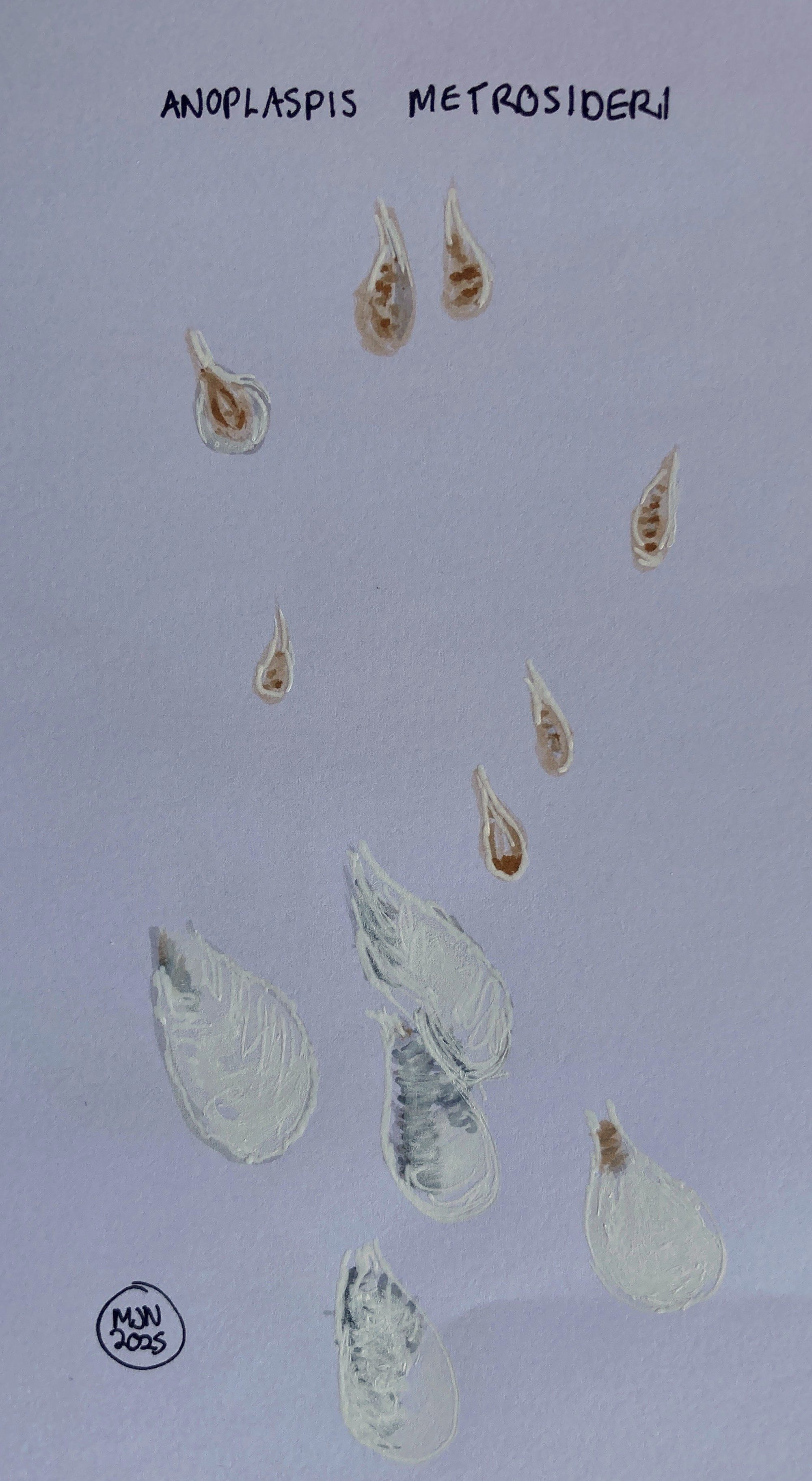
The next insect lives on pōhutukawa as well as related species such as southern rātā. Again, it doesn’t seem to have a common name, but it’s a kind of scale insect. These are insects which move around when they are newly hatched, but then they poke their straw-like tongues into a nice spot on a leaf and make that their home. Mostly they just look like blobs, because they cover themselves in a waxy coating for protection and it’s very hard to see the actual insect.
The final two insects eat a wide range of plants, but pōhutukawa or its relatives are among the plants they eat. The brown evening moth is a large, distinctive moth with boldly patterned wings. Its caterpillars, however, are difficult to identify, because they change colour depending on the plant they are eating. The final insect belongs to a group of longhorn beetles which bore into the wood of many trees, including pōhutukawa and its relatives.


I won’t be writing much for a few weeks, because my brain needs a break, but The Turnstone will be back on January the 4th with something I’m very excited to share with you. In January, voting opens for the 2026 New Zealand Bug of the Year. There are some truly fascinating critters competing for the prize, and I’ll be bringing you as many as I can before voting closes in February.
Wishing you a safe and restful time for Christmas and the New Year.
Merry Christmas! I always love your drawings and thoughtful perspective.
Thank you for a new perspective of the world and the drawings that I deeply enjoy.
Alan Seattle WA.