

Contrary critters
This week's Bug of the Year contenders (4 minute read)

I’ve done something a little different with my illustrations this week. I was having trouble drawing some of the bugs for various reasons. With the cockroach, I couldn’t get the proportions right. With the flatworm, I struggled to convey the texture. With the fly, the only high quality image available was of a dead specimen. Sometimes, I can draw a dead specimen so it isn’t so obvious, but with this one, the legs were in such an unnatural position that I couldn’t.
I decided to try and focus on drawing the lines only, and came up with some different images. I’ve included a few of these so you can see my experiments in technique. Now, onto the candidates. This week, each of the species is something of a rebel, going against a trend or doing something you might not expect a bug to do. I think they are some of the strongest contenders so far.
Otago alpine cockroach | Celatoblatta quinquemaculata
There aren’t many people who will put in a good word for cockroaches. But only two of the species present in New Zealand, both introduced, cause any sort of harm to humans and are considered pests. We have some beautiful and fascinating species – or so I managed to convince my nephew when one of our native bush cockroaches, the golden cockroach, wandered into the house at Christmas.
New Zealand has around 40 cockroach species, most of them native, although I’m not sure of the exact number as the group seems to be neglected by local entomologists. There are 83 volumes of the Fauna of New Zealand series covering terrestrial invertebrates, and as far as I can tell, not one covers cockroaches or termites (their closest cousins).
The Otago alpine cockroach may be the most remarkable native cockroach. As the name suggests, it lives high in the mountains where the weather can change rapidly. Freezing conditions can occur at any time of the year, and this cockroach is ready. It can tolerate being frozen as cold as -11oC, and survive in that condition for several days. Exactly how it does this isn’t completely certain, but it’s complex process involving both sugars and proteins in its body. Although it is freezing tolerant year-round, the concentration of one antifreeze sugar increases during autumn, meaning that it can tolerate colder temperatures in winter than summer.
Why you should vote for the Otago alpine cockroach:
It’s the coolest cockroach around.


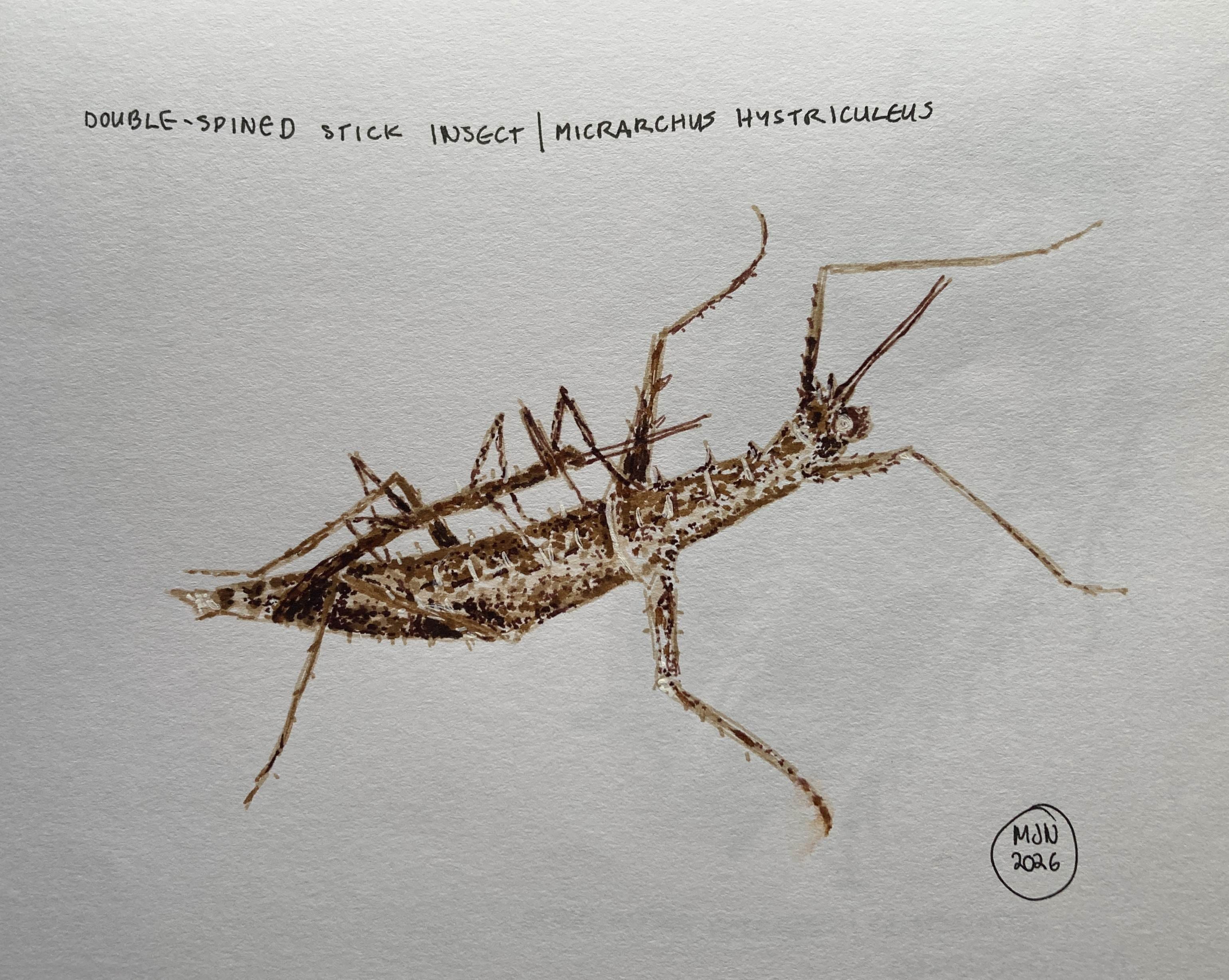
Double-spined stick insect | Micrarchus hystriculeus
New Zealand has about 24 species of stick insect. The double-spined stick insect is one of the smallest and spikiest, with two rows of large spines along its back. It’s found in the lower North Island and north of the South Island.
When I was looking for images of this stick insect to draw, most were of pairs in the act of mating. I wondered why stick insect observers were so obsessed with bug porn. The reason, it turns out, is that males of the double-spined stick insect guard the females through what’s described as prolonged copulation. This can last for several days, and they continue foraging for food during this time.
This sexual behaviour is in sharp contrast to some other New Zealand stick insects. There are eight species of Acanthoxyla stick insect and all these species have only females. The females lay eggs which produce more females.
Why you should vote for the double-spined stick insect:
Shameless!
New Zealand flatworm | Arthurdendyus triangulatus
Flatworms belong to the same broad group as parasitic tapeworms and flukes, but they aren’t parasitic. Most are predators, and the New Zealand flatworm is a predator of earthworms. It spends its days hiding under logs and stones, then goes out hunting at night.
The New Zealand flatworm was accidentally introduced to Britain and Ireland, as well as the Faroe Islands, probably with imported plants. It was first found there in the 1960s, but had probably been there for ten years. Initially it was treated as a curiosity, but in the 1990s scientists realised that it was feeding on some species of native earthworm. It’s now considered a serious problem, able to cause a considerable reduction in some earthworm species, with subsequent impacts on birds and other wildlife.
Why you should vote for the New Zealand flatworm:
Today the British Isles, tomorrow the world!


Sapphire spider fly | Apsona muscaria
‘Come into my lair,’ said the fly to the spider… wait, what?
That’s right, the sapphire spider fly turns the tables on spiders! Newly hatched maggots (juvenile flies) immediately begin looking for a spider host. The spiders live for months with the maggots inside them as they develop, then are killed when the maggot emerges from the fly before it forms its cocoon. Technically, the sapphire spider fly isn’t considered to be a parasite, but a parasitoid. Parasites may live on one or more hosts at various stages in their life cycle, and while they are harmful, they don’t usually kill their hosts. On the other hand, parasitoids spend their entire juvenile development inside a single host and kill it when they emerge. If you’ve seen any of the Alien movies, you’ll get the general idea.
However, once the fly emerges from the cocoon as an adult, it adopts a more conventional fly lifestyle, feeding on nectar. Museum specimens of the adult flies are frequently covered in pollen, suggesting that they play a role as pollinators.
Why you should vote for the sapphire spider fly:
Do you really need to ask? If you know of a fly with a more bizarre and unexpected life cycle, I’d love to hear about it.


Very interesting (as always) Melanie. Your new (line) drawings are lovely.
Absolutely fascinating and captivating! Thank you!