

Hemlock and old lace
The delicious plant family with some deadly deceivers (12 minute read)

The spice drawer in my pantry is an aromatic array of memories. Each jar contains dried plant fragments: shards of bark, chunks of root, brittle leaves, flower buds, berries, seed pods, seeds, or any of these ground to a powder. Unscrewing a lid wafts an intense fragrance out of all proportion to the desiccated fragments inside. Each is distinctive, unique, evoking memories of places and people as vividly as any photograph. Cinnamon reminds me of the delicate cakes my mother would fill with whipped cream for family celebrations. I remember that I first tasted cardamom sitting on a sofa covered with colourful handmade blankets in the cramped lounge of a school friend. A whiff of turmeric takes me back to an unpretentious beachside café in Mauritius, where I ate some delicious fried octopus. Fennel takes me to the Dalmatian coast of Croatia, where one of my uncles gave me dried fennel stems to chew.
While the smells of spices awaken distant memories, as a botanist I categorise them into plant groups. Both green and black cardamom, as well as turmeric, for example, are cousins to ginger, while clove is a member of the myrtle family. Mustard is a kind of brassica, while chillies are related to capsicum, tomato and potato.
One plant group stands out among all the others, though. Coriander, cumin, fennel, caraway, black cumin and carom, not to mention a few which I don’t have, such as asafoetida, all belong to the same botanical family. So, too, do many herbs best eaten fresh, such as parsley, dill, chervil, cicely and lovage. The more I look for them, the more I find – Caribbean culantro1, Georgian dootsi, Persian golpar and the laserpicium of ancient Rome. There are flavourful vegetables, too, celery, carrot, parsnip and Florence fennel. All are members of what’s commonly known as the carrot family, or Apiaceae to botanists.
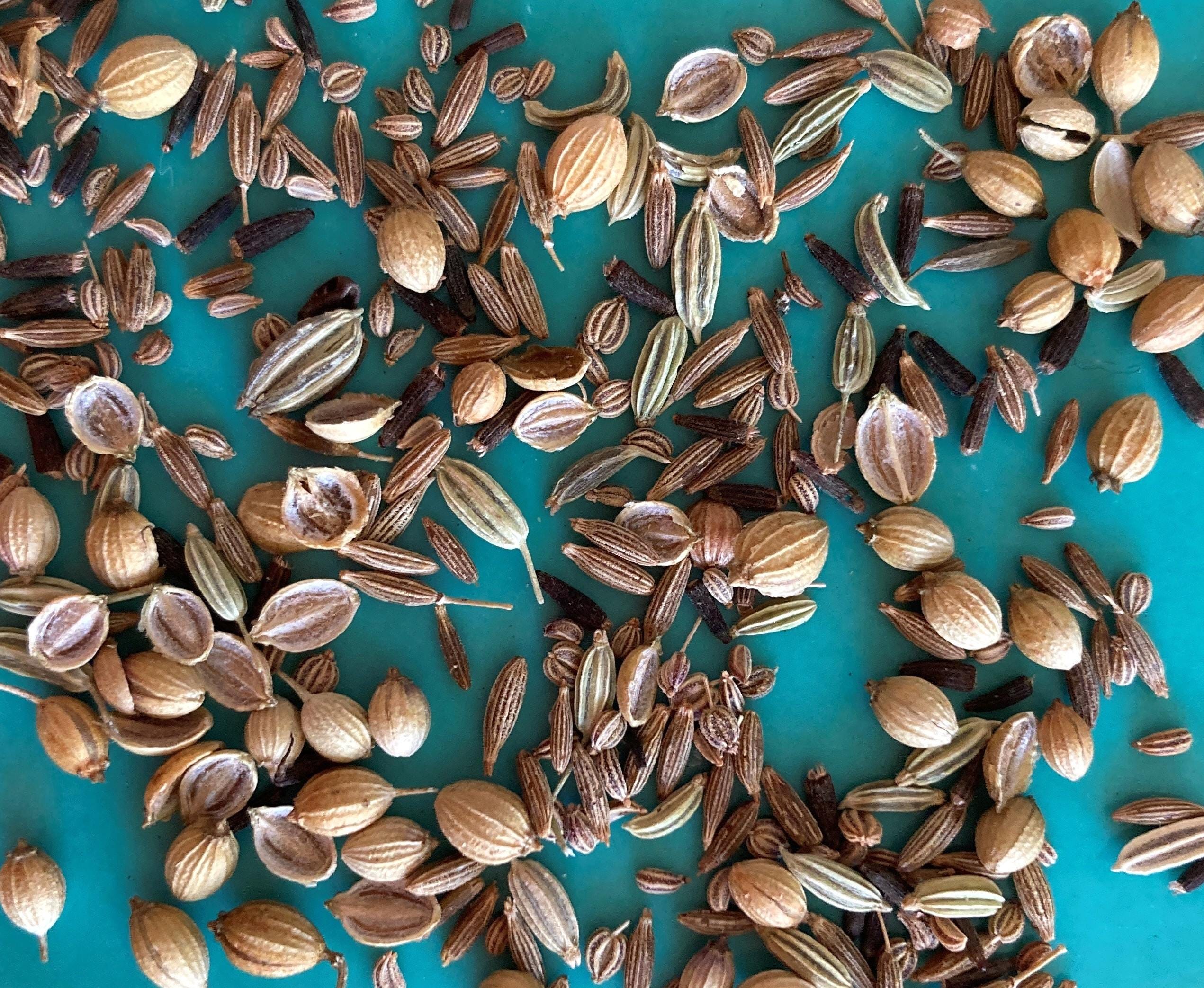
The carrot family is a culinary catalyst, transforming everyday meals into delicious dishes. Without it, my curries would be bland and my winter soups insipid. But among the abundance of flavours, the family hides a dark secret. Some species are dangerously toxic, and distinguishing the delicious from the deadly deceivers is no simple matter.
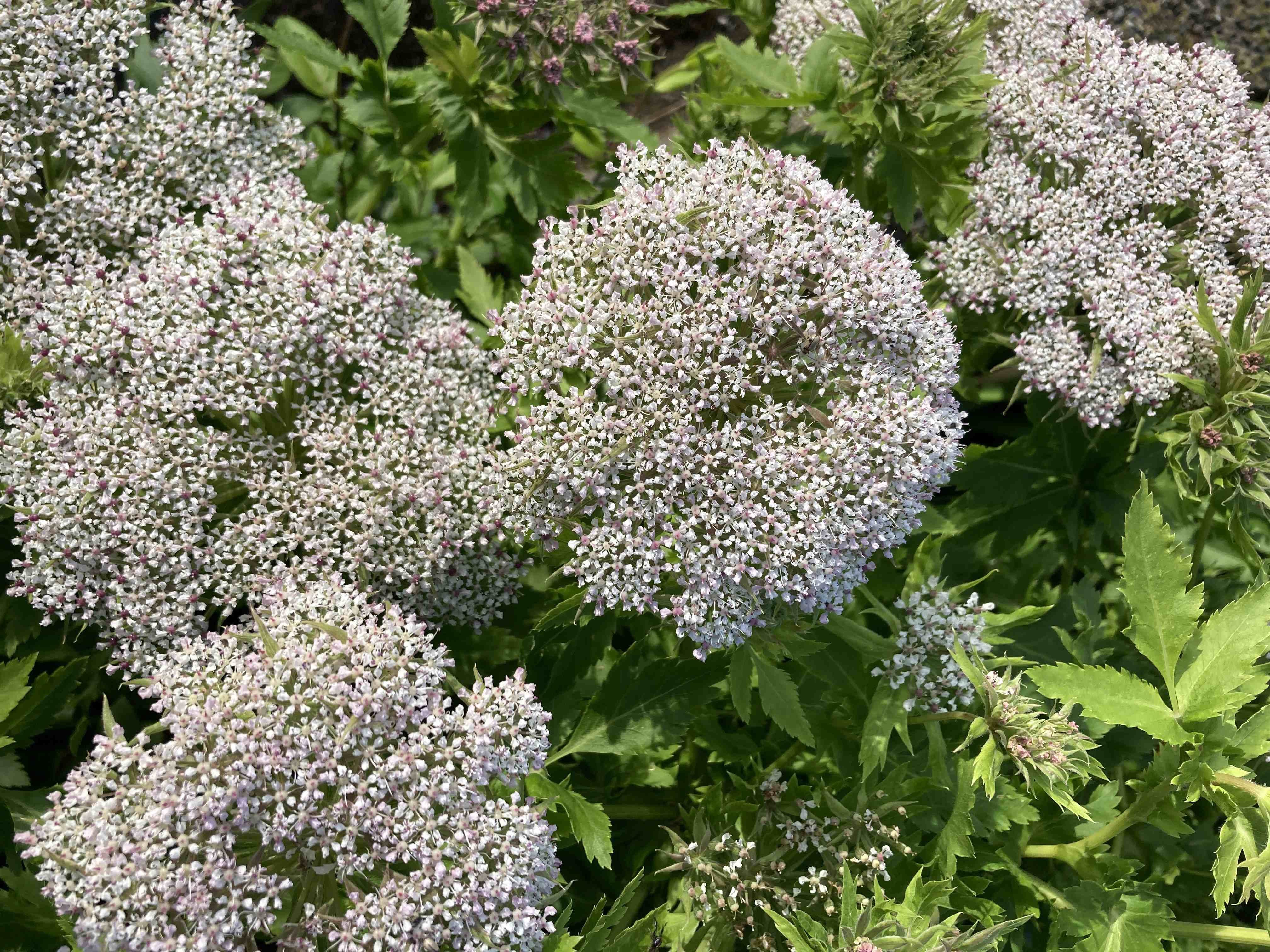
Almost all members of the carrot family have an appearance which makes them easily recognisable as related. If you’ve ever grown a carrot or parsley in your garden, you’ll be familiar with the feathery foliage which sprouts from a central point at ground level, like the fronds of a fern. Each ‘frond’ is a single leaf – there is no stem. Leave the plants for too long, or plant them in the wrong season, and they will eventually begin to grow a stem, which has similar but smaller leaves and branches to a greater or lesser extent. At the top of the stems, flowers form. The individual flowers are tiny, but they form broad clusters with a somewhat umbrella-like shape and a lacy appearance. These flower clusters gave the family its earlier botanical name of Umbelliferae2.
So far, most of the plants I’ve mentioned as part of the carrot family more or less have this typical form, with the exception of culantro, which I will get to soon. So, too, do a number of other plants from the family which you might have encountered, such as angelica, Queen Anne’s lace and giant hogweed. But there are exceptions. There’s a group of plants known as sea hollies, many of which, as their name implies, are coastal and have hard, spine-edged leaves like those of the holly tree. Culantro, native to Central and South America, and the Caribbean islands, is a member of this group. New Zealand has one species of sea holly too, an uncommon little plant usually found in disturbed coastal areas and declining due to coastal development and weed invasion.
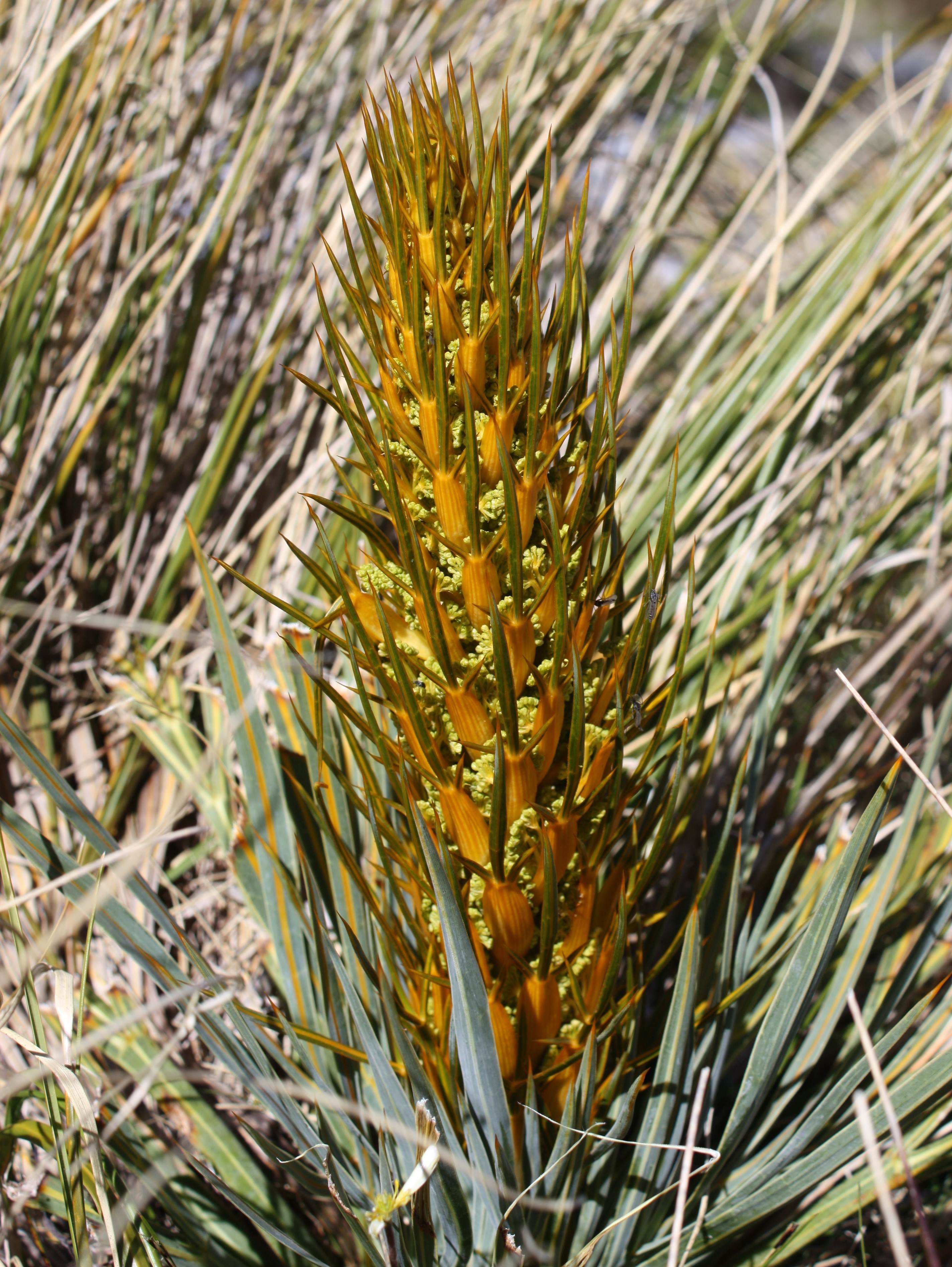
New Zealand has around 50 native species which resemble typical members of the carrot family, more or less. However, we have one group which looks so unlike a carrot it’s hard to believe they are related. Taramea or speargrasses, are among our most spectacular plants. The leaves are long and narrow, ending with a sharp point. When they flower, they send up a tall spike, also covered with spiny leaves. Some species do have a typical umbrella-like shape, but most have flower clusters along the stem, so that the whole flower stem is more like the spire of a cathedral.
On closer inspection, it’s possible to see the resemblance between taramea and other members of the family, by looking at the leaf bases, the individual flowers and the seeds. However, you do this at your peril. I’ve been spiked many times trying to look at the flowers or take photographs.
The most unusual members of the carrot family are the woody species, those which grow as scrambling vines or shrubs. New Zealand has a couple of these, generally described as sprawling shrubs, although one is more like a vine and one closer to a shrub. Other parts of the world have these too, but they are uncommon in comparison with the more typical members of the family.
For some time, botanists have debated where the precise boundaries of this family lie. One of my books places the carrot family with the ginseng family, which is mostly made up of trees and shrubs, with some vines and smaller herbs. Ivy is a member of this family, as are New Zealand’s five-finger plants and our spectacular pukanui tree, native to Manawatāwhi (the Three Kings Islands), off New Zealand’s northern tip. The current thinking has the two families separate again, but a group of plants known as pennyworts, which are mostly small groundcovers, was reclassified from the carrot family to the ginseng family in 2004.
Aside from the unusual species and those at the blurred boundaries, it’s easy to identify a plant as belonging to the carrot family once you have a basic idea what to look for. What’s less easy, however, is identifying these plants beyond the level of family. Aromatic, feathery foliage growing from a central point at ground level, tall stems with smaller leaves, ending in lacy, umbrella-shaped clusters of tiny flowers – this could be a description of an overgrown carrot. It could be chervil, cicely, coriander or caraway. It could be parsley, dill or fennel. It could be water celery, an edible weed. Or it might not be.
While there are numerous toxic plants, there aren’t many which can be deadly even in small quantities. On that deadly list are hemlock3, water hemlock and hemlock water dropwort4, all members of the carrot family, all matching the same basic description as the edible species. The precise number of deadly species in the carrot family is not clear, because there’s limited data for some of the lesser-known plants in those three groups. As far as I can tell, four species of water hemlock5 are deadly, and hemlock’s closest cousins are potentially just as dangerous. But the dropworts, a group of around 40 species, vary widely in their toxicity. One species is a commonly eaten vegetable in parts of Asia, one is deadly. The rest have varying levels of the dangerous toxin, but none are associated with significant poisonings. The total number of people killed is small, for example, 10 people died in the UK between 1900 and 1978 from eating hemlock water dropwort. Nonetheless, it’s considered one of the most dangerous plants for foragers because of its resemblance to edible plants. It continues to cause occasional deaths among foragers, as does water hemlock. Both species have a high fatality rate, with only a few grams considered a potentially lethal dose.
The most infamous plant in the carrot family is hemlock, because of its association with the execution of the ancient Greek philosopher, Socrates. However, there have been centuries of academic debate about which plant actually killed him.
Plato, who witnessed the death of Socrates, refers only to farmakon, the Classical Greek word for poison. He describes the death as peaceful, with a paralysis beginning in his lower limbs and travelling up through his body until he died. The references to his cause of death come centuries later, when some Greek writers refer to Socrates being killed with kôneion. This doesn’t mean they were being fanciful, as kôneion was a well-known poison used for executions, described by other Greek writers. However, around the same time a Greek-speaking doctor named Nicander wrote a description of death by kôneion which bore little resemblance to that by Plato. The difference between Plato’s account, Nicander’s description and more recent experience with poisonings by plants in the carrot family led some scholars to theorise that Plato wasn’t so much describing a death as representing a philosophical idea.
When Classical Greek was translated into Latin, such as in the work of Pliny the Elder, kôneion was translated to cicuta. By the 1600s, cicuta and variations such as cicutaria were being used in Europe for a number of different poisonous plants in the carrot family. In England, the word hemlock, also used for a number of species, was added into the mix. Poisonings were infrequent enough that most people knew of the symptoms only from books, but with no standardised naming it was often unclear which plant was being referred to.
In the 17th century, a Swiss physician treated eight children poisoned by a plant he called cicutae aquaticae. All suffered violent seizures and two died. He noted the disparity between the symptoms he saw and Plato’s account, not realising that the disparity was due to imprecise plant names. When Linnaeus standardised the naming of plants, he clarified confusion about many species, but when it came to hemlock he made matters worse. He assigned the name Cicuta to hemlock which grew in wet areas (water hemlock) and Conium, based on the Greek kôneion, to the hemlock which grew in drier places (hemlock). He used another Classical Greek plant name, Oenanthe, to refer to what we now call hemlock water dropwort.
Linnaeus’s Cicuta, the plant which poisoned the Swiss children, doesn’t grow in Greece, but hemlock and hemlock water dropwort do. However, hemlock water dropwort, like water hemlock, causes violent convulsions, and could only be the cause if Plato’s account was pure fiction. There is still debate about how accurate Plato’s description is, with some suggesting it is medically accurate and others suggesting he left out the most unpleasant symptoms such as vomiting. However, it’s now widely accepted that the poison which killed Socrates was indeed what we call hemlock, the plant Linnaeus and subsequent botanists called Conium.
The carrot family has one other dark secret which makes it a plant group to treat with caution. More than 30 species, including some which are edible, have chemicals in their sap which can cause skin to become highly sensitive to sunlight. While other plants can also cause sensitivity to sunlight, there are more species in the carrot family with this effect than in any other plant family. In some cases, particularly those associated with hogweed species, the resulting irritation can be severe, with swelling, blisters and long-lasting scarring.
The most toxic members of the carrot family grow in temperate areas of the Northern Hemisphere. Giant hogweed, associated with some of the most severe skin damage, is native to Europe and Asia, but invasive in North America, which also has its own toxic hogweeds. In New Zealand, giant hogweed has been grown as an ornamental plant and it is now found growing wild here as well. Hemlock water dropwort is native to northern Europe and the Mediterranean, and doesn’t seem to have spread from there. A few related species have spread to New Zealand, but these are non-toxic species, or at least not dangerous. The water hemlock species are native to temperate regions in the Northern Hemisphere, and also don’t seem to have spread. True hemlock, however, is a successful invasive species and is now found around the world in temperate areas. There’s plenty growing in New Zealand.
For those with an interest in foraging, members of the carrot family are tempting. There are a number of delicious and abundant wild species. But I always advise foragers to avoid the carrot family unless they have well-developed botanical skills. Foraging for wild plants in the carrot family is less dangerous in New Zealand than in Europe or North America, where the deadly species look and smell even more like edible species. But it’s still no beginner’s game.
Not cilantro, the American name for coriander, but something entirely different.
Both umbrella and Umbelliferae are derived from a number of Latin words related to shade, such as umbra.
Conium maculatum. In North America, the name hemlock is used for a group of conifer trees, and the poisonous plant is known as poison hemlock. The trees apparently were given the name because the leaves of some species smell similar to hemlock.
Oenanthe crocata
Cicuta bulbifera, C. douglasii, C. maculata and C. virosa. I haven’t found information one way or the other on C. mexicana.