

Regenerating heritage
Remembering what Christchurch has lost, and finding hope in the Red Zone (10 minute read)

A light rain is falling and I’m getting some rare value from my umbrella. Anyone who has spent time in my home city, Wellington, will know that umbrellas are largely useless there, because there are few wet days which aren’t also so windy that umbrellas risk being blown inside out. But I’m in Christchurch for a few days, attending the Science Communicators of New Zealand conference, and the rain is falling downwards instead of sideways.
The weather is exactly as I remember it from when I lived here in the 1990s. There’s a chill which envelops the city, beneath an unmoving layer of heavy grey cloud. There’s no chance of seeing the sun. Dusk will fall on this dreary day without the temperature either rising or falling more than a few degrees. Not every winter day is like this, of course. I remember that the winter was sometimes glorious, with frosts and clear skies. Sometimes snow fell, infrequently enough that it was always a delight. But on a day like this, looking up at the branches of bare, English trees against an oppressive sky, I remember how much I struggled through the darkness and cold of a much harsher winter than I’d ever encountered in Auckland, where I grew up.
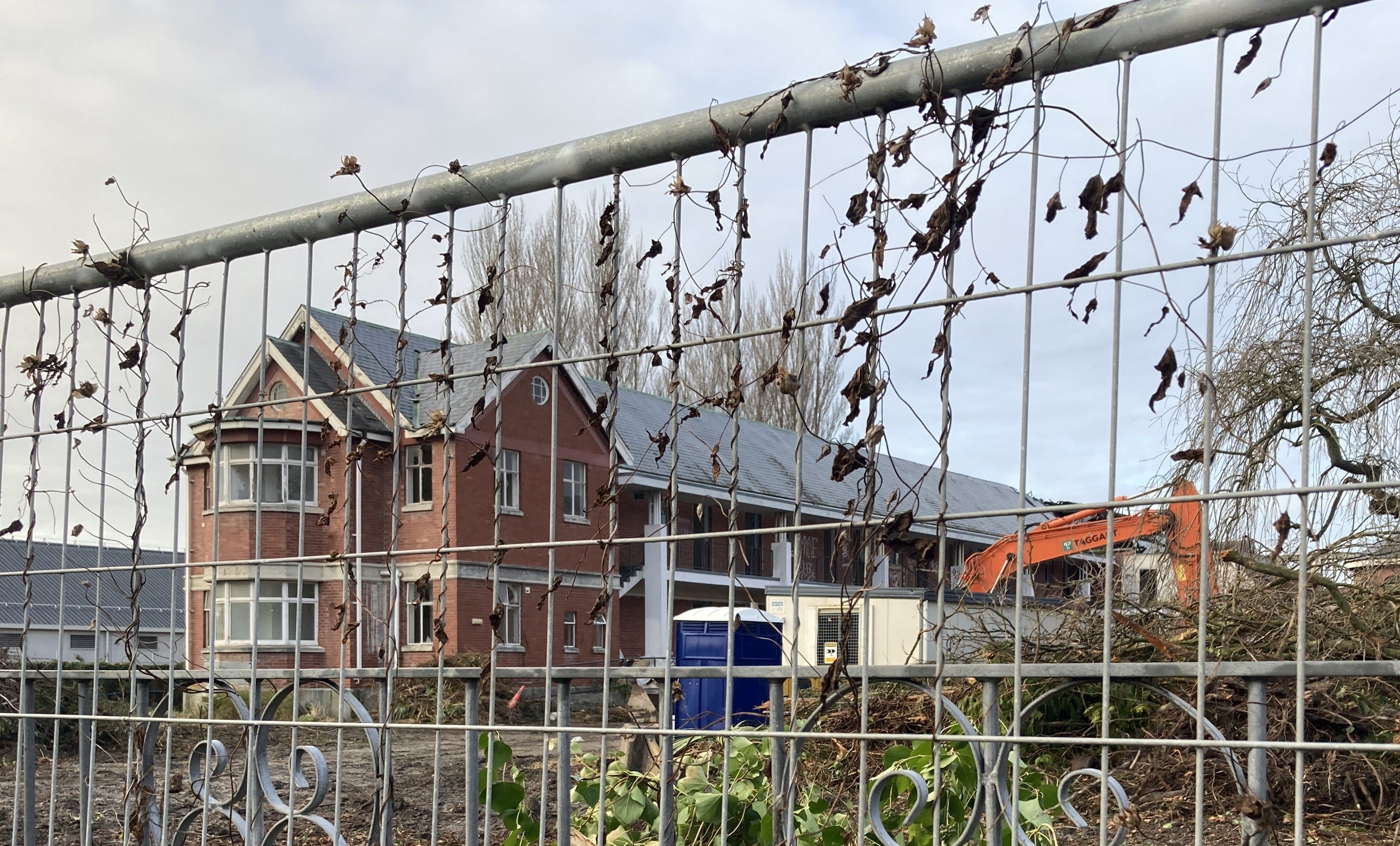
There’s much that’s still familiar to me about Christchurch, but it’s not the same city. So many of the old stone and brick buildings which gave central Christchurch its character are gone. The suburbs have sprawled westwards and areas I remember as rural are now subdivisions. Temporary fencing, around damaged buildings or vacant sites, is still common. I walk past one building, originally built as a mansion then later a Catholic seminary, which has been dying a lingering death for over a decade. It was considered a heritage building, but its owners chose to let it deteriorate until it was beyond repair and its heritage status was removed. Now, it’s being demolished.
Two of my favourite buildings, the copper-domed Cathedral of the Blessed Sacrament and the music centre in a converted convent next door, were demolished after the earthquakes fifteen years ago. In time, there will be another cathedral, but the old cathedral, once considered the finest Renaissance Revival church in the Southern Hemisphere, was unique and special, both for the city and for me personally. The cathedral and music centre introduced me to some of my favourite music, when I sang in the cathedral choir. But the resonant acoustics will never again echo with the angular rhythms of Guillame de Machaut, the radiant harmonies of Frank Martin or the vast time and space evoked by Arvo Part’s sparse notes.
Today, though, I’m looking for a different kind of heritage. It’s much older than any cathedral, in this country or elsewhere. It was also more systematically obliterated than Christchurch’s old buildings, by a force more destructive than any earthquake – our human determination to bend nature to our will.
Before people arrived here, the land bounded by the Waimakariri River in the north and Te Waihora (Lake Ellesmere) in the south was a vast wetland. Some was forested with a canopy of lofty kahikatea trees, some had a lower canopy with broadleaved trees and some was regenerating forest with mānuka and kānuka. Other areas were more open, with grasses or grassy-looking plants such as sedges, which dominate in conditions too wet for most grasses.
But the original vegetation is almost entirely gone now. Both Māori and Pākehā settlers cut down and burned forest, and Pākehā also drained the land to make it more suitable for farming and housing. Only a tiny fragment survived the destruction. Today, it’s known as Riccarton Bush or Pūtaringamotu, and it’s one of Christchurch’s beloved treasures.
I have a vague memory of visiting Riccarton Bush in the 1990s, and I remember finding it a little disappointing. It struck me as similar to, but less impressive than, Smith’s Bush in Auckland, another tiny, fragile fragment. Both forests are dominated by kahikatea and both have been drained so the soil beneath them is much drier than when the trees established. Smith’s Bush, though, also has a grove of massive pūriri trees which I have always loved. Riccarton Bush, I remember, had introduced trees such as sycamore and elm among the kahikatea, as well as many other introduced plants. I was saddened that this degraded remnant was all that Christchurch had left of its ancient heritage.
Today, I arrive at Riccarton Bush under a gloomy sky with half an hour to spare and my knee complaining that I’ve kept walking on it despite an injury a couple of weeks ago. But the rain is light and the ground is flat, and I’m determined to visit the forest. As I approach, I can see immediately that something important has changed. Surrounding the forest is a predator-proof fence, with access through a double gate. Such fences are expensive, even those around small fragments. It’s the first sign that this forest is being nurtured with great care.
Once I’m inside, I can hear the difference immediately. It’s true that the birds I see and hear are common species, pīwakawaka (fantail), riroriro (grey warbler) and tauhou (silvereye). But I haven’t heard them anywhere else as I’ve walked through the suburb of Riccarton, and I remember them being uncommon when I lived in Christchurch. In this protected forest, though, they are darting through the trees in ways I’m used to seeing in Wellington, where native forest is regenerating on every scrap of land too steep for humans to tame. The chill air is bright with their chatter and the forest feels more vibrant for their presence.
Underfoot, I can see another change in the forest. I’m walking on a boardwalk, raised around half a metre above the ground. Like predator-proof fences, boardwalks are expensive, but they do much more than keep my boots clean. They open the forest to more people; it’s possible to take a pushchair, wheelchair or mobility scooter into a place which would otherwise be inaccessible.
The boardwalks aren’t there only for people, though. They are good for the forest. They discourage people from stepping off the track and trampling on plants or compacting the soil. The occasional person wandering through the undergrowth isn’t likely to do much damage, but when a forest is in an urban area, it’s never just one person. Even if people are trying to stay on the tracks, in this kind of forest the tracks get muddy. People skirting the mud end up widening the tracks and muddy footwear carries weed seeds and plant diseases too.
As I walk, I can see that the forest has a healthy undergrowth of small-leaved shrubs, including at least one species, rōhutu, which is in some trouble nationally. I do see some trees which I recognise as introduced, but it looks as if at least some of them have been killed, although it’s difficult to tell in mid-winter, when deciduous trees have lost their leaves. Other than these trees, I don’t see many other weeds, another sign of the care taken of this forest.
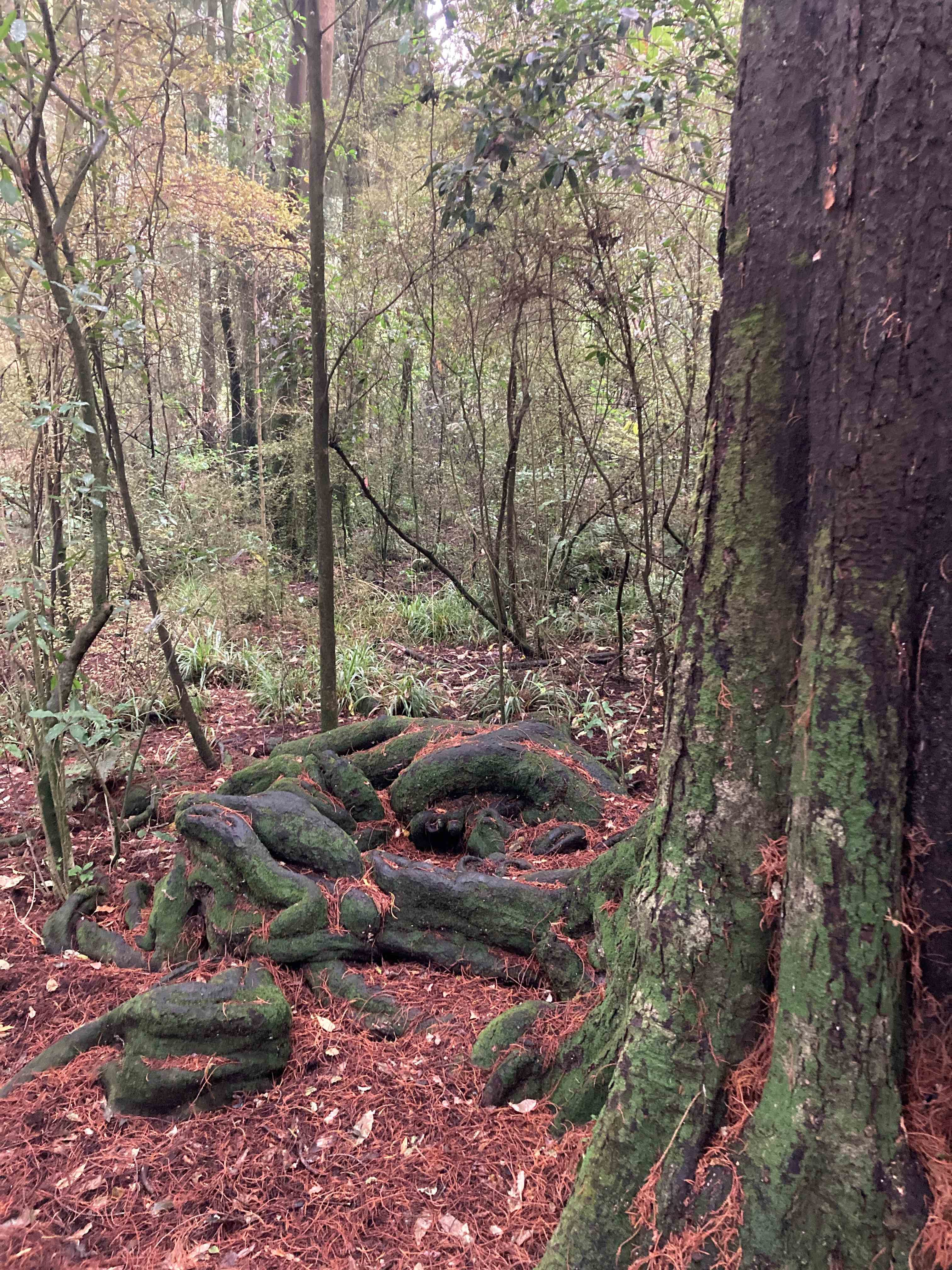
One thing I notice, thinking back to my comparison with Smith’s Bush, is that there are some truly ancient kahikatea trees here. Most of the kahikatea trees in Smith’s Bush are relatively young, but some of the trees in Riccarton Bush are massive and estimated to be as much as 600 years old. Surrounding them are their surface roots, like writhing eels on the forest floor. The roots entangle with each other and give the trees greater stability. I take the time to admire the lovely roots and take a few photos before I move on.
It’s heartening to see the improvements in Riccarton Bush since I was last here, but it’s bittersweet. Riccarton Bush is simply too small, only 7.8 hectares in total, around the same size as Smith’s Bush. It’s surrounded by suburbia and there’s nowhere else for nature for miles around. It will never support the rich growth of delicate filmy ferns and mosses typical of intact forest, because the interior will never be sheltered or humid enough to support them. Nor will it support the abundance and diversity of birdlife encountered in Wellington, which spills from Zealandia into the surrounding suburbs. The forest has nowhere else to grow. It will be preserved and protected and loved, but it’s like an endangered species which now exists only in a zoo or botanical garden. It will survive, but it doesn’t feel like a wild place.
Riccarton Bush makes me realise how lucky we are in Wellington. We wiped out our native forest almost as comprehensively as Christchurch did, but our steep terrain meant that there were areas we never built on. For years they grew nothing much other than gorse, but from the remaining native forest, Wellington re-wilded itself. We’ve helped the process along, by planting native seedlings and controlling invasive mammals, but much of the transformation has happened simply because we gave nature the space.
This comparison is on my mind as I join the field trip for my Science Communicators Association conference. It’s being held at Christchurch’s Climate Action Campus, a place for students from Christchurch’s schools to learn about climate change. But, I soon learn, it’s so much more than that.
The Climate Action Campus was founded in 2019 by former Christchurch mayor Vicki Buck, as a satellite school for Ao Tawhiti Unlimited Discovery School. It uses the site once occupied by Avonside Girls High School, on the edge of Christchurch’s largest Red Zone1, more than 600 hectares of land stretching from the city to the sea, which once held more than 5000 homes. The campus itself is a collection of scattered prefab buildings brightened by colourful murals and gardens interspersed with patches of broken asphalt. There’s no doubt it’s run on a shoestring, but it’s a joyful place. We are shown around by some of the students, whose enthusiasm overflows as they tell us about this place they clearly love.
When the Climate Action Campus was founded, around eight schools used it; today it’s used by more than fifty. The campus is also used by community groups, including weavers, pounamu2 carvers and an art programme for adults with intellectual disabilities. Climate change means that the students who use this campus face an uncertain future with challenges their parents and grandparents probably never imagined. But the Climate Action Campus is building a community for them which will make those challenges easier to bear. It’s a place of hope.
As part of our field trip, we leave the campus and walk into the Red Zone. We are shown a garden which has been created to support native insect life and walk along part of an 11 kilometre shared walking-cycling path, which runs along the bank of the Ōtākaro-Avon River. I walk down broken streets, where there’s little sign of the lives lived here other than curb cuts where there were once driveways and a few hardy shrubs where there were once gardens. And I realise that out of the tragedy, grief and suffering, Christchurch has been given a gift.
For those who endured the awful years following the first of the earthquakes in September 2010, I realise it may not give much solace. But, one day, this area will bring a vital energy to the city, its green spine, where nature has space to regenerate. It will take decades, generations in fact. Those who enjoy the forests and wetlands along the corridor of the Ōtākaro-Avon River will not be those who endured the earthquakes. But, one day, kahikatea trees, descendants of those which survive in Riccarton Bush, will grow tall on this land. Their entangled roots will hold them firm in the unstable ground, even in Canterbury’s wild north-westerly winds and during floods caused by our increasingly extreme weather. These trees are yet to be planted, but after feeling the hope which the Climate Action Campus brings, I know that they will be.


For those outside New Zealand, Red Zones are areas where the land was considered to damaged to build on after the Christchurch earthquakes.
Also known as greenstone. It’s mainly nephrite jade but the name pounamu also refers to some kinds of serpentine.
😁 I hear you about rain & umbrellas in different places ! Having lived in several different cities (including Wellington & Christchurch) Invercargill & Wellington were the worst, Dunedin was pretty umbrella friendly, Blenheim - well the sun shone MOST of the time & there was seldom much wind with any rain 🤗, and Christchurch is a mixed bag closer to Dunedin for a combo of wind & rain. Not sure where I would put Timaru in that ?
I agree about the Christchurch river corridor being one upside of the destructive EQs & look forward to revisiting plantings as they become less like a series of markers beside twigs & more like growing trees - there is nothing like returning after an absence and seeing the fruits of the community's labours thriving & foreshadowing what they might become (long after my lifespan!) That is another decided upside - the enthusiasm with which citizens, both prominent & unknown, had the vision & the passion to recognise the opportunities out of disaster & make so many good things happen 💐
BTW - in all my years in Christchurch I have been to Riccarton Bush ONCE - for an outdoor picnic, and actually had no idea that there was actual "bush" as opposed to it being a generic name 🤷 As an avid backcountry bush person with vast rivers & valleys & mountains part of the normal package it seemed so unlikely, but just like the "bush" areas of the Botanic Gardens it has it's own place in nature - your description of the birdlife sold it for me so guess where I am going on the next nice day I have free 🤗