

Return of the screw
The story of a fly we thought we'd defeated (12 minute read)

I’ve just made my post-lunch coffee and am back at my desk when one of my irritating office companions barges in. Since I work on my own at home, this isn’t an annoying human, though. It’s not my cat, wet from rain, leaping onto my desk and flopping down in front of my keyboard, inadvertently bumping the delete key with her head. Nor is it my dog nudging her head under my hand as I’m moving the mouse. Usually, the next step after that is pawing at my leg, whining and staring at me with an intensity which reminds me that one of the names for her breed is eye dog. It can be annoying when I’m trying to concentrate, but she can easily be redirected by tossing a few dog treats onto the floor.
My office companion today is more distracting than any of my pets. It’s a great big blowfly, which must have flown in while I was giving my dog a break in the garden at lunchtime. The blowfly buzzes into the room, collides with the window a couple of times, buzzes around some more, takes a short break, buzzes around my head, collides with the window again then flies out of the room. I can see it colliding with the window in the next room, and know it will be back in my office soon. I won’t be able to concentrate unless I get rid of it one way or another.
I usually just open a window and let it fly away, but as I’m doing so today, I notice that I feel a trace of guilt at my laziness. The idea of flies as pests which should be killed is deeply ingrained. As a young child, I was so aware of my grandmother’s efforts with a fly swat that I distinguished her from my other grandmother by referring to her as Nana Flies. Despite my great love of the natural world, I am still revolted by blowflies, and I feel as if I should have killed the blowfly in my office rather than releasing it.
As someone who has spent their career working with invasive species, I do understand that there are times when we need to kill one species if we want to protect others. But the feeling that I should be killing flies is something different. I don’t even know whether the fly bothering me is a native or an introduced species. I do know that having a fly in the house walking all over my kitchen is unhealthy, but I don’t know whether this particular blowfly is harmful or beneficial in the wider environment. Adult blowflies pollinate many flowers, while the immature flies (maggots) are important decomposers, but its contribution to environmental health is far from my mind when a blowfly is buzzing around my office.
Blowflies are a group of around 1500 species of fly which are found around the world. They are usually large flies and often have metallic-coloured bodies, giving rise to names like bluebottle and greenbottle. According to a 1985 review, New Zealand has a little over 40 native species and around 8 which have been introduced. None of the native species is considered threatened, but around a quarter are naturally uncommon. I’ve looked at the information about the different species, and it’s likely that most or all of the blowflies which annoy me are introduced, although there’s one native bluebottle which is fairly common around Wellington.
The human relationship with blowflies is complicated. Many, probably most, of us find them disgusting to some degree. This is understandable, because disgust is generally considered to be an emotion which evolved because it helps us to avoid disease. But we also benefit from their service as pollinators and decomposers and have harnessed their abilities in surprising ways. Last year, I wrote an article aimed at younger readers about the use of maggots to clean infected wounds and to determine the time of death in forensic investigations. The main maggot used in medicine is a blowfly known as the common greenbottle, and blowflies are the most frequently used insects for forensic evidence.
Perhaps the most disturbing thing about blowflies, though, is that some of them have a taste for living flesh. Mostly, it’s our livestock which suffer, but they will even feed on humans under some circumstances. Eleven blowfly species are reported to sometimes live as human parasites, causing damage to healthy tissue. This most often happens when blowflies colonise a wound, whether caused by injury or illness. It is also more common when people don’t have access to washing facilities. One of the blowflies which most often causes this kind of infection is the same one we use to treat wounds, the common greenbottle. It’s not clear to me why we are able to rely on it for medical use when it sometimes attacks healthy tissue, at least I haven’t found a specific answer. But there’s a world of difference between placing a few maggots grown in sterile conditions on a wound in a therapeutic setting and wild blowflies laying eggs on an untreated wound of someone forced to live in squalor.
Blowflies also cause a condition known as flystrike, which affects livestock, particularly sheep. From short-coated wild sheep which shed their fleeces every year, we have bred sheep with long fleeces which they retain unless shorn. As a result, the fleeces often become soaked with urine and faeces around the sheeps’ hindquarters, leading to inflammation of the skin and attracting blowflies. The blowflies lay eggs and the maggots can cause painful, debilitating and sometimes fatal wounds. Flystrike is a particular problem in New Zealand and Australia, because sheep graze over extensive areas with little human contact for most of the year.
The blowflies which cause flystrike, including the common greenbottle, are opportunists. They lay their eggs on live animals when conditions are suitable, but they mostly live on dead animals. A small number of blowflies, however, can only grow in live flesh. The most notorious of these is the New World screwworm fly, so-called because it is native to North and South America and the maggots have rings of small spines around the body. It’s commonly called the screwworm, so as much as it pains me to call a fly a worm, screwworm it is.
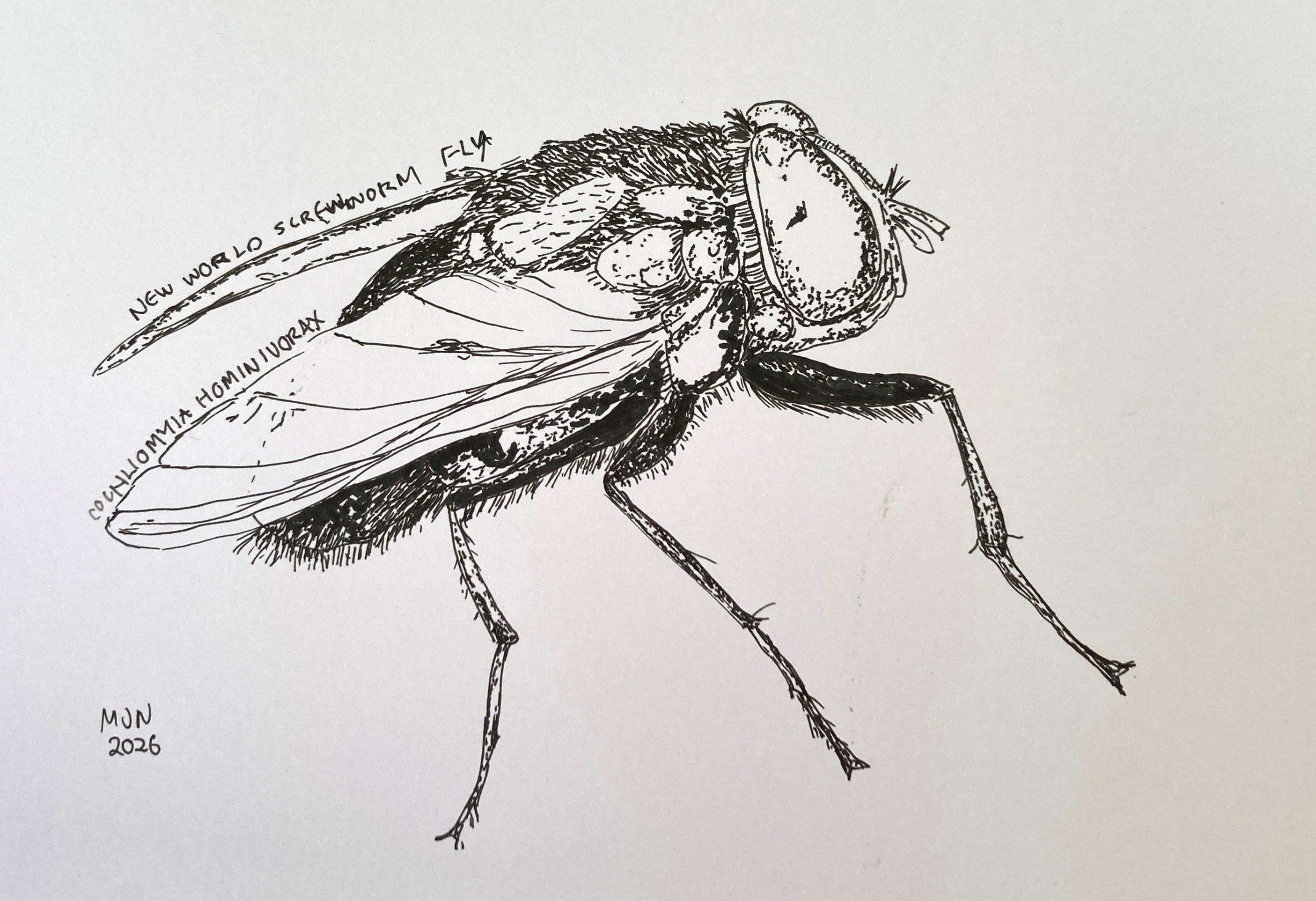
The story of the New World screwworm is often presented as a triumph of science and veterinary medicine, because it was eradicated from a large part of its range to protect livestock. But a closer look at this tale raises some uncomfortable questions about how we perceive biodiversity. It is also a cautionary tale for those who take an isolationist view of human, animal and environmental health.
The screwworm differs from other flies which lay their eggs on humans and other mammals, which are attracted to infected wounds or some other foetid smell, such as filthy wool. The screwworm is attracted to fresh, bloody wounds and these don’t need to be large. Sometimes, a bite from a tick can be enough to allow a screwworm entry and the fly also lays its eggs inside the nasal passages of young animals. Once the screwworm eggs hatch, the maggots burrow themselves deep into the flesh, a habit which is also sometimes given as the reason for their name. As a result, the wound becomes painful and debilitating. Severe cases can be fatal.
The indigenous people of North, Central and South America must have been aware of the screwworm, but I’ve not been able to find any indigenous names or information about it prior to the mid-19th century. In 1858, the fly and its maggots were described by a French scientist in Guyana, who noted the severity of the illness or injury which resulted. In North America, however, scientists were unaware of the difference between the screwworm and other blowflies. They advised farmers that screwworms bred in dead animal carcases, so burning carcases was the most important control measure. It was only in the 1930s that scientists realised that the screwworm was different from the blowflies which live on carcases.
The problem became more urgent in 1933, when cattle carrying screwworms were shipped from the southwest USA to the southeast, where the screwworm didn’t occur. Scientists began to study the screwworm more rigorously. They developed a method of rearing large numbers of screwworms on a mixture of ground meat and beef blood, which made their research considerably easier. They also discovered a particular quirk in the way the screwworm bred. Female flies mated only once in their lifespan of 10-30 days, although males mated multiple times. US Department of Agriculture scientists at a research station in Texas wondered whether the flies could be controlled by releasing sterilised male flies, which would mate with the females but leave them unable to lay fertile eggs. The idea, however, remained hypothetical, as there was no way to sterilise large numbers of male flies.
While the understanding of screwworms progressed over the following decades, they still caused large economic losses as well as the suffering of livestock. By the 1950s and 1960s, the losses were estimated to cost farmers US$50-100 million per year. But the scientists who had the idea of sterilising male flies found an ally in a fruit fly researcher who had discovered he could sterilise his fruit flies with radiation. So, they began experimenting. They figured out the radiation dose which would sterilise screwworms but not harm them enough to affect their ability to fly and mate. Then, they tested their method on Sanibel Island, off the Florida coast.
For three years, they dropped large numbers of sterilised flies from a plane, and showed that this did, indeed lead to a drop in screwworm numbers. However, adult flies can fly many kilometres, particularly when seeking favourable conditions. Sanibel Island was too close to the Florida mainland for eradication to be possible.
Just as they were ending their experiment in Florida, a vet on on the island of Curaçao, 40 kilometres from the Venezuelan coast, wrote to the US Department of Agriculture for advice on controlling an outbreak of screwworm. The scientists offered to test their method on the island. It was a complex operation, rearing hundreds of thousands of flies at a facility in Florida which had been used for the Sanibel Island operation, sterilising them with radioactive Cobalt-60 then sending them to Curacao. Within seven months of the first sterile fly releases, they could find no fertile screwworm eggs on the island. The screwworm had been eradicated.
Once the method, known as the sterile insect technique, had been proven, ranchers in the US were keen to see it used there. The intial efforts focused on Florida and southern Georgia, which were the only areas in the southeastern USA where the screwworm could survive the winter. While it would spread northwards in warmer weather, the fly could be eradicated by wiping it out in Florida and southern Georgia.
This would require a staggering number of flies. Work began on a facility which could produce 50 million sterile flies per week. Even before it was finished, though, the eradication was well underway, as a harsh winter meant that the screwworm had been wiped out everywhere in the southeastern US except for southern Florida. Most of the work was completed a year ahead of schedule, with just a few small outbreaks which were quickly controlled.
Up until this point, the screwworm was being eradicated from parts of the USA where it wasn’t native. But with the success of the programme in the southeast, southwestern ranchers wanted their land free of screwworm as well. The scientists pointed out that it would be impossible to protect the southwestern USA without controlling the fly in Mexico, so the two countries worked together on a truly massive eradication programme. Another huge fly-rearing facility was built and by the time the USA achieved screwworm eradication in 1966, the facility was producing 150 million sterile flies per week. A barrier zone was maintained in Mexico through the ongoing release of sterile flies.
However, the eradication was not to last. There were still sigificant populations of screwworm in Mexico, and these continued to spread to the USA. Efforts moved to Mexico, with an even larger fly rearing facility established in the south of the country. By 1985, screwworm had been eradicated from all but the southeastern part of Mexico. Scientists looked further, and determined that Panama, and specifically the narrow isthmus where Central America connects to South America, would be a more practical barrier. Over the next 15 years, they eradicated screwworm from all of Central America. A fly-rearing facility was built in Panama to maintain the screwworm free zone.
The desire to eradicate screwworm is entirely understandable, but I also have to acknowledge here that the fly is native to all of these areas, from the southwestern USA and throughout Central America. I haven’t found a single paper considering whether there might be some environmental or ethical concerns with deliberately wiping out a native species over such a large area. The only reference I’ve found which points this out is a 2022 paper from Uruguay. The paper looked at the interactions of the screwworm with other species, not just the animals it feeds on, but predators and parasites of the screwworm, plants which it may pollinate and other species which may be kept in balance by competition with screwworms. Although acknowledging that there was only limited information, the paper concluded that there were no other species entirely dependent on the screwworm and so its eradication probably wouldn’t have major environmental impacts. That may very well be correct, and I’m not saying the eradication was wrong. These kinds of decisions are value judgements and there was widespread support for the eradication among those affected by it. But I still find it remarkable that it took until the 2020s for this question to even be asked.
The story of the screwworm doesn’t end here, though. There’s another twist. In 2023, the screwworm crossed the Panama barrier and has been spreading northwards ever since. Just a few days ago, the first case in US cattle was detected. Why this has happened isn’t entirely clear, although the timing suggests that disruptions to production due to the COVID-19 pandemic may have played a role. Illegal transport of livestock may have been a factor, as well as difficulties maintaining effective surveillance over such a large and politically unstable area.
The USA managed to rid itself, and its neighbours, of this costly and damaging pest once before. But it only did so because of innovative government scientists and cooperation with the countries south of the border. Whether it is able to achieve a similar feat today remains to be seen.
What a fascinating read with a thought provoking question about eradicating a native species. Thanks for this read.
👏Fascinating ... both the "eradication" efforts & the ethical dilemma. Personally hate flies buzzing about inside & potentially contaminating surfaces they land on, but being aware of their place in the natural order I have a split personality solution! INSIDE they are pests & subject to fatal removal (usually spray, but electronic zappers & fly swats aren't unknown) and outside I ignore them, or if I have to work in their vicinity put on my insect screen hat that I use for working in sandfly (NamuNamu) country.
🤔On balance the Screw worm fly seems like one of those creatures with no/almost no redeeming qualities, but stunning that no-one had asked about unintended consequences 😱 With the sheep (and Northern Royal Albatross chicks on the Otago Peninsula) protection against being fly-blown is via drenching (sheep) or localised spray (Albatross) - I wonder why they went for eradication (so complex and expensive) rather than individual animal treatments as part of routine farming operations?🤷 As for the current re-infestations - Mother Nature constantly reasserts herself to show us puny humans who is boss eh ⁉️🙄