A coming storm
Ominous clouds on the horizon, both literal and metaphorical (2 minute preview, 5 minute full article)

Breaking news
I wrote the following article before I heard that bird flu had been detected in New Zealand. Now I’m worrying about our birds more than the storms, although the storms are still on my mind. I will keep an eye on the situation and will write something when I know more. In the meantime, I’ve written two previous articles about bird flu which are still relevant. The first looks at the history of the bird flu pandemic and some of the impacts overseas. The second article was in response to a bird flu detection in Otago in 2024, and explains the science of flu subtypes, as well as some of the threats to humans.
Death on the wing

In wild birds, influenza A mostly causes few signs of disease. Apart from one outbreak, which killed thousands of terns in South Africa in the early 1960s, it wasn’t considered to be a problem for wild birds until very recently. But chickens were another matter. The first records of bird flu killing chickens date back to the 1870s, when it was known as “fowl plague”.
As the flu flies

Flu in birds is also classified by severity. Many forms cause only mild disease, and are classified as low pathogenicity. Forms which cause severe disease are known as highly pathogenic. New Zealand has long had forms which cause mild disease in our bird populations, but not severe forms.
The bird flu detection in Otago two years ago was a very different situation from the one we face today. The Otago outbreak was an isolated incident, awful for those at the centre of it, but not a wider threat if well-managed. The bird flu detected on Wednesday is the disease we have been watching overseas and worrying about for years. It’s The One and now it’s here.
The Ministry for Primary Industries, which is leading the response to bird flu, is asking people to immediately report any sightings of 3 or more sick or dead birds to their biosecurity hotline on:
0800 80 99 66.
You may want to take photos from a distance, but do not touch sick or dead birds. Bird flu is a threat to humans as well as to birds.

Owning a high-energy dog has made me aware of the weather in a way I never was before. It wasn’t that I didn’t notice the weather, especially when Wellington’s sideways rain coincided with times I was travelling to and from work. But, in the past, I usually minimised the time I spent outdoors when it was unpleasant. Now, though, I don’t have a choice. Donna expects her morning walk and won’t settle without it. So I’m out every morning, no matter how wild the wind or torrential the rain.
Donna and I have experienced plenty of horrible weather, but I’m starting to wonder if it’s getting worse. A couple of weeks ago, I mentioned some of the damage Cashmere Park has suffered in storms. It’s clear that this reserve has long suffered from the savage southerly winds which are funnelled between the steep hills. So many of the trees and shrubs are growing sideways, after being knocked over in one storm or another.
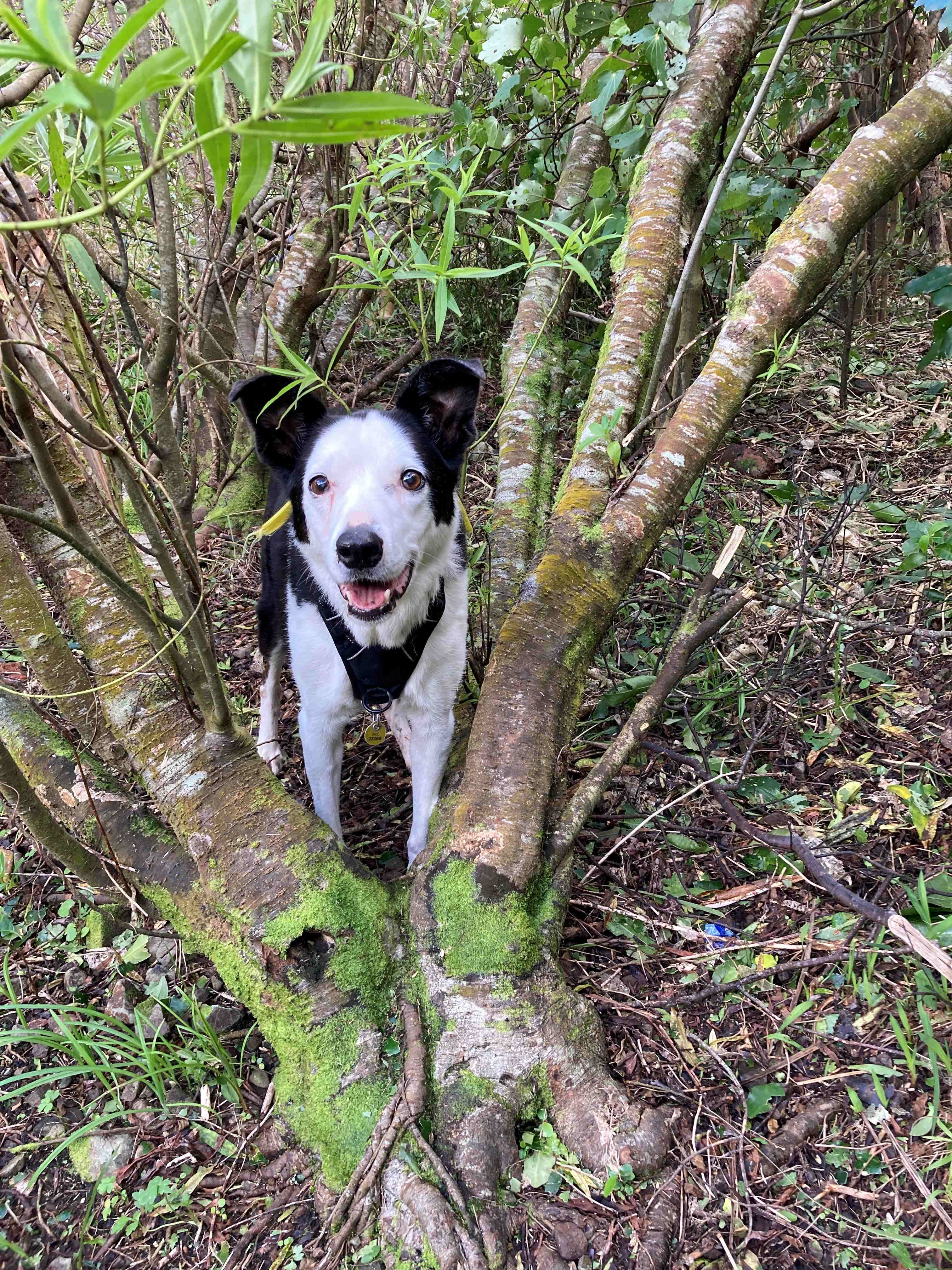
Here’s one of the koromiko trees, which blew over years ago. The track up to the main restoration site goes right through the middle of it. You can see where Donna is standing; that’s exactly where the track goes. You walk up the slope and step through the tree, as if it’s a magic portal. It always makes me smile as I pass through on my way to a place which brings me joy.