

A tenacious tangle
Unravelling the mysterious origins of New Zealand's strange shrubs (11 minute read)

Every time I walk on the Skyline Walkway, the track along the windswept ridge which runs from Johnsonville to Karori, I wonder about the strange, small-leaved shrubs. Along most of its length, the Skyline Walkway passes through a mix of rough pasture and shrubland dominated by two spiny invasive plants, gorse and Darwin’s barberry. It might appear that there’s not much to interest a botanist. However, among the spiny invaders there are some intriguing shrubs with tiny leaves and masses of entangled twigs. At first glance, they all look similar, but close observation reveals subtle differences in colour and form. There’s more to these odd-looking shrubs than it might seem.
I’ve been wanting to learn more about these shrubs for some time, and so I offered to lead a Wellington Botanical Society field trip to the area. Leading a trip didn’t mean I had to know all the plants, but it meant I could walk there in the company of botanists who know more than me, so I could absorb some of their knowledge. The trip was last Saturday, so I’ve taken a break from invasive species to write about the wonderful weird plants which grow there.
New Zealand’s small-leaved shrubs are so numerous that there’s a 290 page book about identifying them. They can be difficult to identify, as many appear superficially similar. Many of them adopt an unusual growth habit with their twigs branching frequently and at wide angles. This growth habit, known as divaricating, results in plants where the branches are interlaced. Under a forest canopy, where light levels are low and conditions more moderate, divaricating shrubs grow loosely and simply appear a little messy. But when they grow in the open, as they do along the Skyline Walkway, they form dense, impenetrable tangles of twigs, with the little leaves and delicate growing shoots protected inside.
There are at least 60 species which meet the strict definition of divaricating shrubs in New Zealand. There are also a number of trees which are divaricating when young, then mature to a more conventional growth form. The trait appears to some degree in about 10% of our woody plants. Overseas, though, divaricating plants aren’t common. To my knowledge, the only other place with a great diversity of divaricating plants is Patagonia. Why does New Zealand have so many?
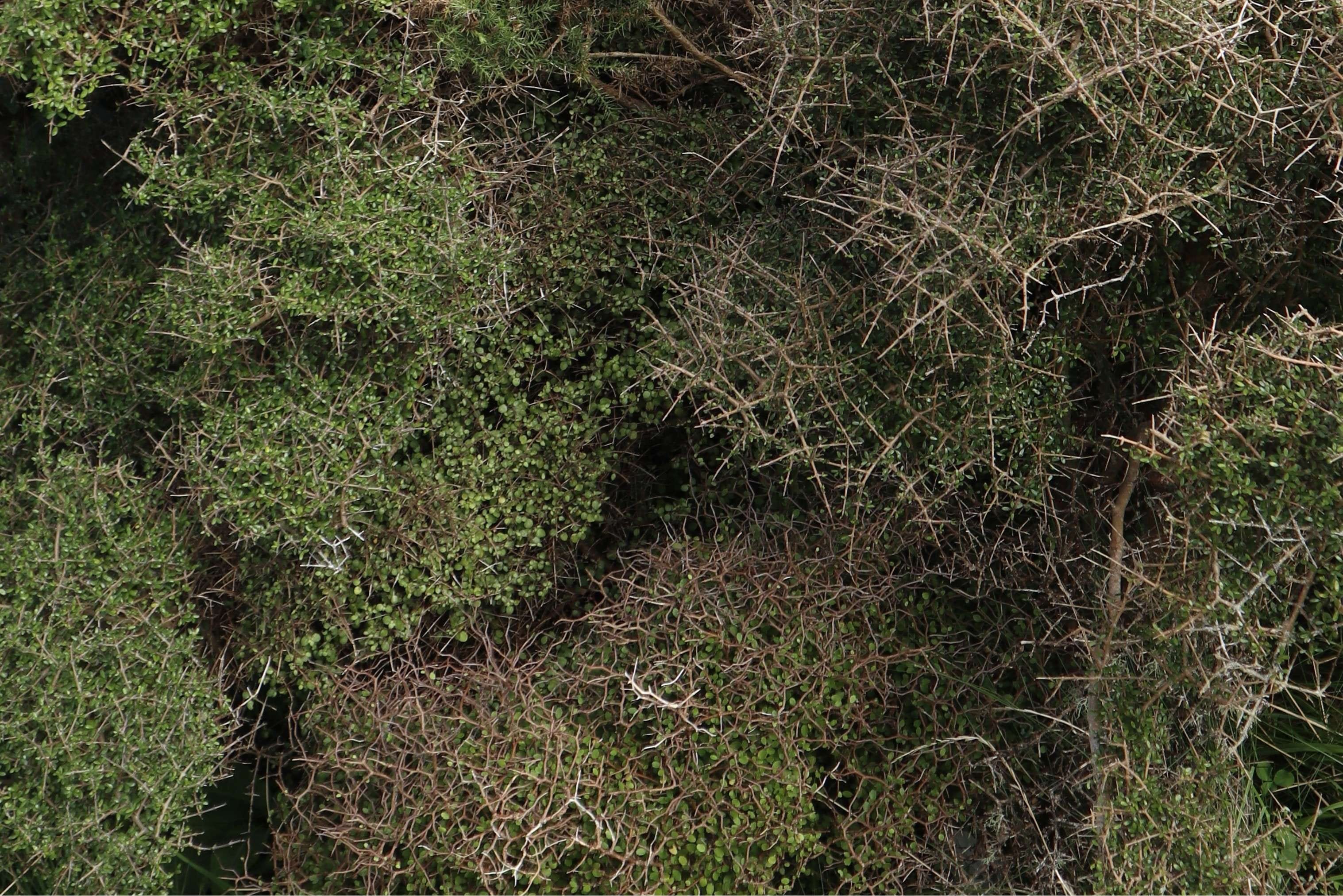
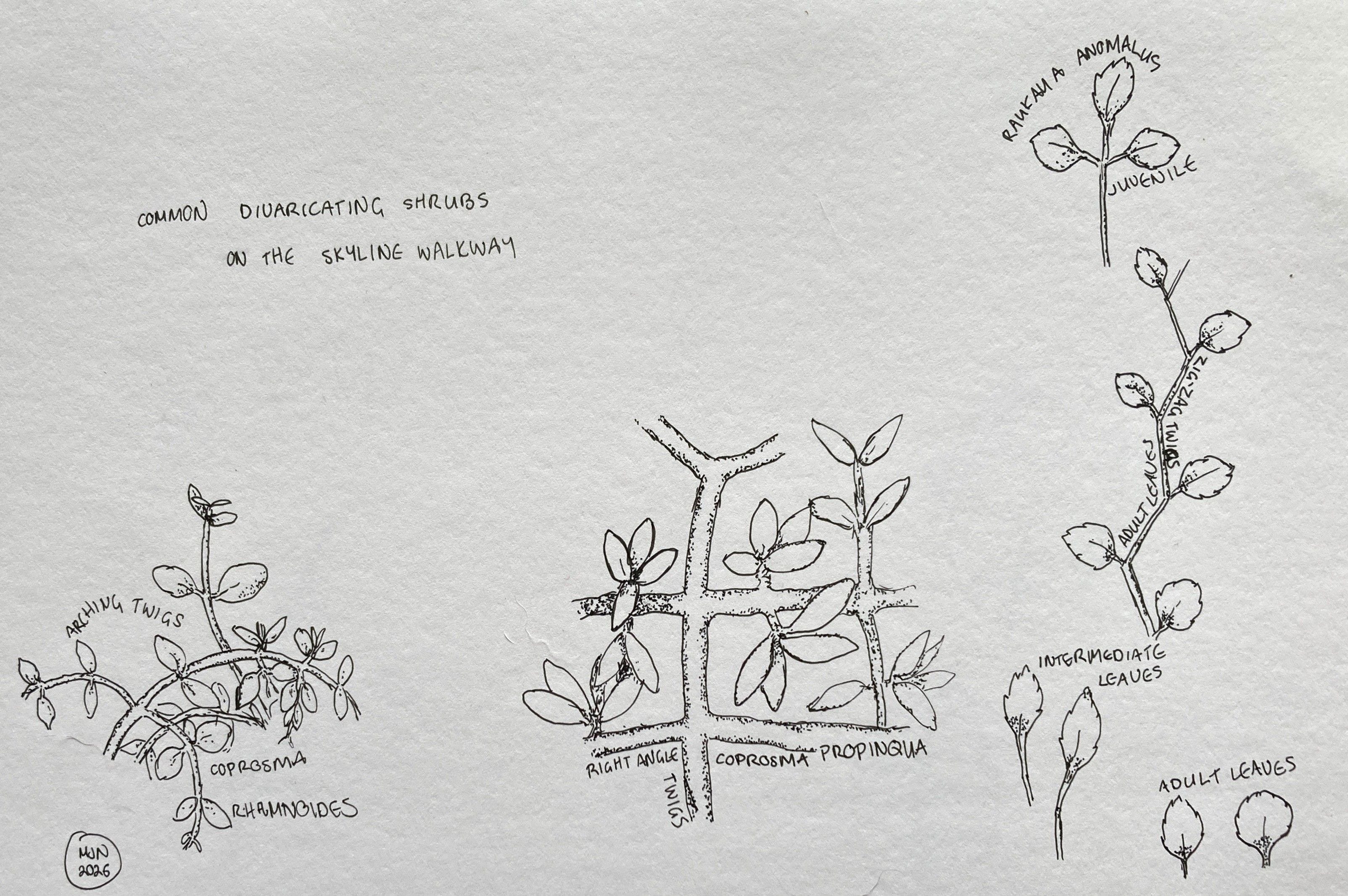
To answer this, I first have to step back and look at which plants are divaricating. On the Skyline Walkway, at least five of them are species of Coprosma (that’s the plant with a scientific name which literally means smells like poo). However, other divaricating shrubs are unrelated. Rōhutu, a threatened shrub found in places along the walkway, belongs to the myrtle family. Its closest relative is a small tree called ramarama, which is not divaricating. One of the most common divaricating shrubs in the area, which doesn’t appear to have a common name, is related to raukawa, with large, glossy, fragrant leaves. They are members of the mainly tropical ginseng family. Another is a cousin to Wellington’s most common native tree, the māhoe, which also has large leaves and is a member of a mainly tropical family.
This diversity can be found along just a short segment of track in Wellington. Elsewhere in Wellington, and in other parts of New Zealand, there are even more divaricating plants. They can be found in the citrus family, the daisy family, the pea family, the dock family, the fig family, the buckthorn family and several other families which don’t have common names and are less well-known.
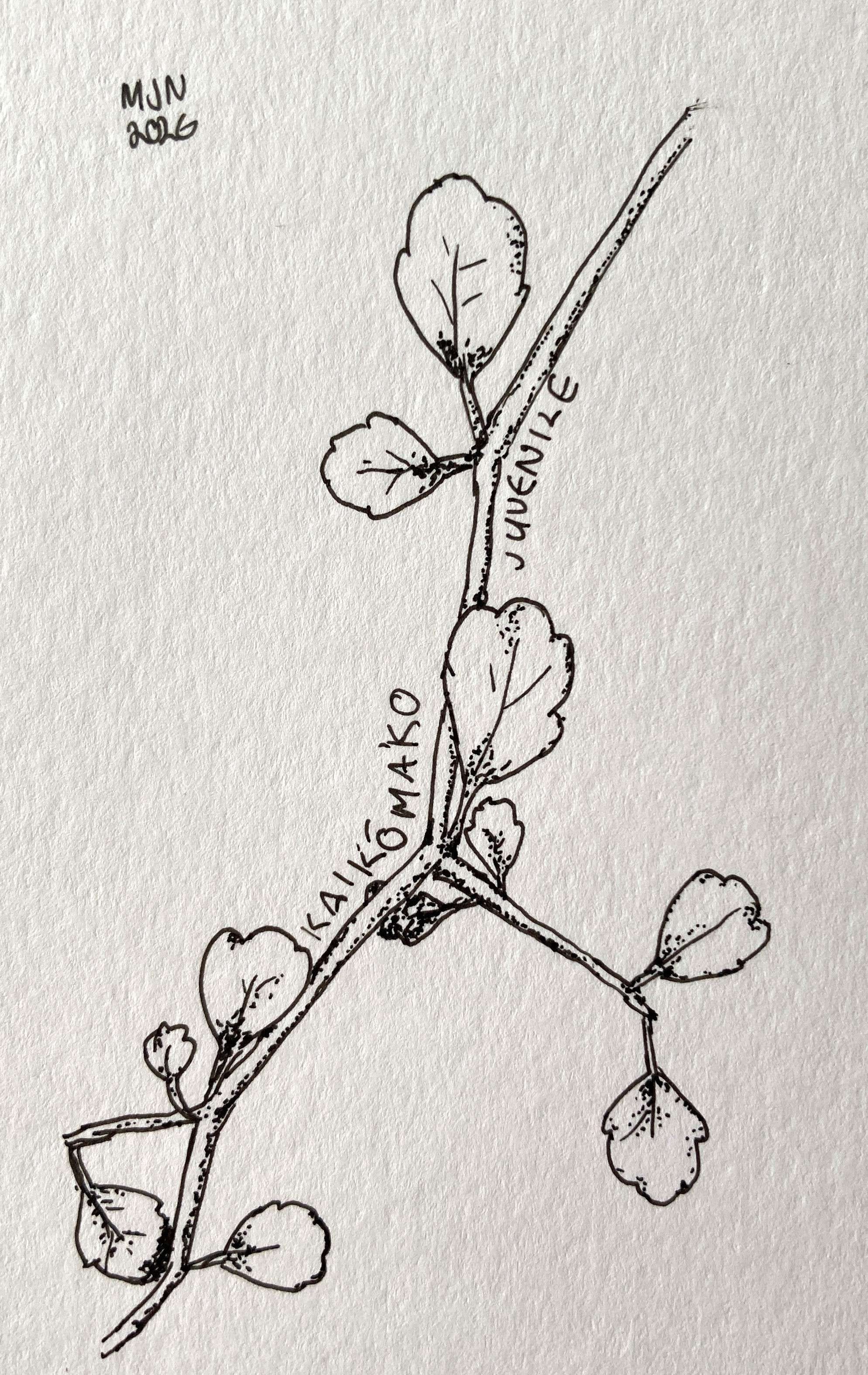
When we consider the plants which are divaricating when small, but are not when adult, the range widens further. Our tallest tree, the kahikatea, is divaricating when small. So, too, is its cousin, the mataī. Both of these trees are classed as conifers, or cone-bearing plants, rather than flowering plants. One of our kōwhai species is divaricating when small. On the Botanical Society field trip, we spotted a tree called kaikōmako which had divaricating twigs with small leaves lower down and larger leaves on non-divaricating twigs higher up. The closest relative of kaikōmako is a tree with large, glossy leaves found only on Manawatāwhi (one of the Three Kings Islands).
When we look at the wide range of botanical groups which have divaricating plants, and the fact that they are related to non-divaricating plants, we can learn something important about this growth habit. It’s not something which evolved once. Our divaricating plants did not all inherit this growth habit from a single divaricating ancestor. Instead, the growth habit has evolved repeatedly.
This kind of evolution is not uncommon. It’s called convergent evolution, because unrelated species converge on a similar feature or trait. Birds, bats and insects, for example, all evolved flight independently. Opposable thumbs are another example. Humans, chimpanzees and gorillas all have opposable thumbs we inherited from the same ancestor in the distant past. The American opposum and giant panda have opposable thumbs too, but these have no relationship with our thumbs. The thumb of the American opossum is similar to ours, in that it evolved from one of the digits. However, the opposum has thumbs on its hind and not its front feet. The panda’s stubby thumb is even weirder. It evolved from one of its wrist bones, which means it still has five other digits on its paw.
These examples, though, are limited. Traits such as wings and opposable thumbs aren’t evolving frequently. But New Zealand has dozens of divaricating shrubs and, by my count, the trait has evolved around 20 times. That is assuming all the divaricating species of Coprosma evolved from a single divaricating ancestor, which is unlikely, given that the divaricating species are not all closely related.
Something in the New Zealand environment, then, has uniquely favoured small-leaved shrubs with tangled twigs. Even in Patagonia, where there are a number of divaricating plants, they are less common and typically less extreme in their form. But what is this unique feature of New Zealand?
The answer is far from clear. There are competing ideas, but none has been confirmed with any degree of certainty.
The frontrunner among the ideas has long been that the growth form is favoured by New Zealand’s climate, particularly our constant winds. Early botanists put forward this idea and noted that the dense branches create an interior environment which is more sheltered. We were able to see this for ourselves on the field trip – many times one of the group would disappear head-first under a patch of shrubs to look at delicate plants underneath. The small leaves, spaced a long way apart, also don’t rub against one another when buffeted by the wind, which reduces damage and water loss.
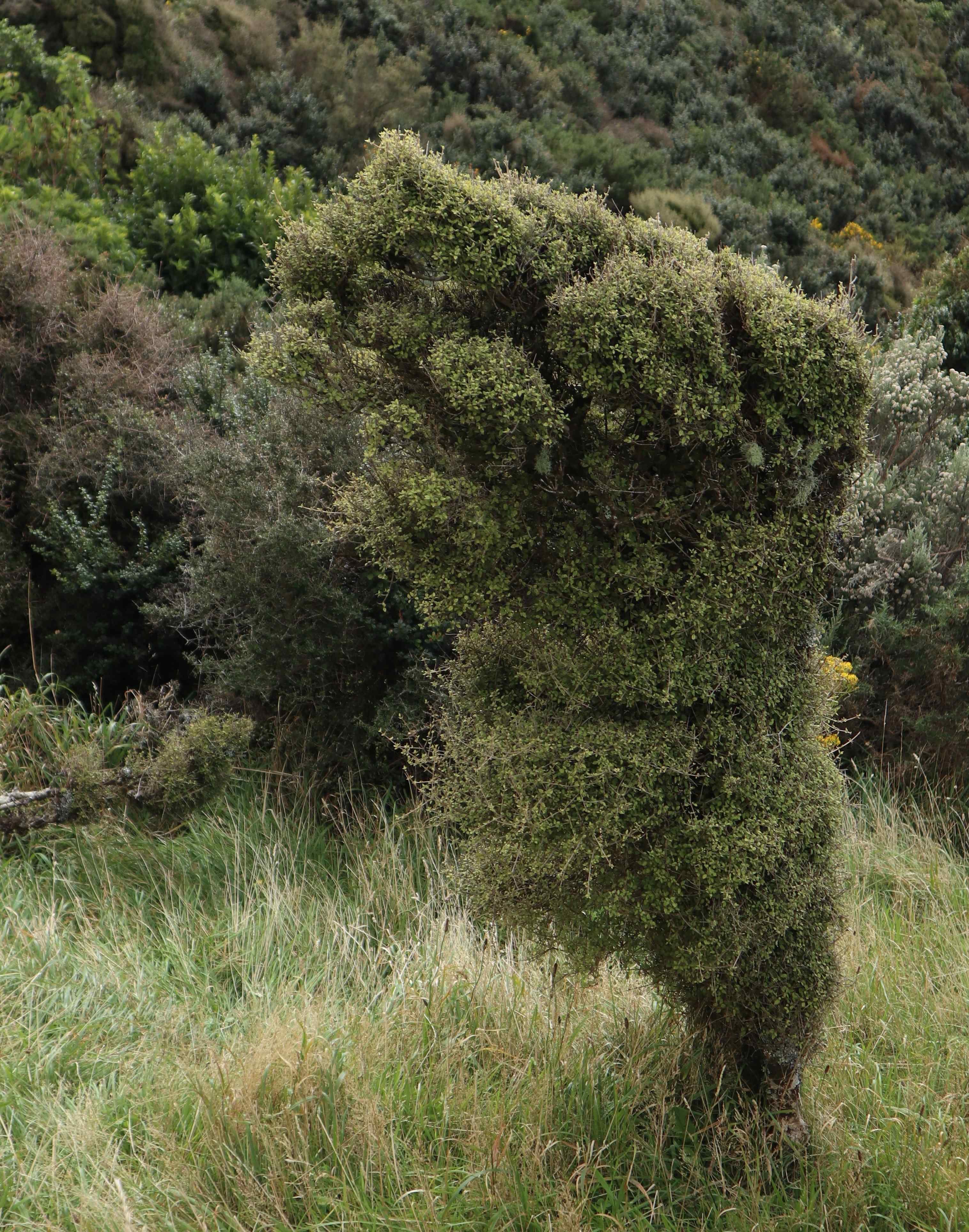
Later refinements to this idea proposed that it wasn’t only wind, but also frost, which contributed. Frosts in continental climates may be more severe than in New Zealand, but they are highly seasonal. Plants simply lose their leaves for the cold season and regrow them when it warms up. In New Zealand, freezing temperatures can be found in any season, including mid-summer, as anyone who has been in Wellington for the last few months can tell you. Another variation suggests that the outer branches protect the leaves from high light levels under cold conditions, which can cause damage.
There’s merit in these arguments, but they have some problems. Along the Skyline Walkway, where the plants are constantly blasted by Wellington’s wind, it’s easy to see climate as the cause. But experimental studies haven’t always backed this up. And it doesn’t explain why some forest trees are divaricating, particularly when many trees which tolerate exposed conditions, such as the hardy māhoe, are not. The climate idea also doesn’t explain why forest trees are divaricating when they are small, but not when they are mature.
An alternative idea is that it relates to the light conditions in New Zealand forests. Plants which have different juvenile and adult leaf forms are reasonably common, but they are particularly abundant in New Zealand’s forests. It isn’t only the divaricating trees which do this. The fascinating horoeka (lancewood) grows a single, spindly trunk with stiff, narrow leaves 30 cm or more long. Eventually the spindly trunk becomes stouter, begins to branch and grows shorter, wider, softer leaves. There are numerous examples of weird juvenile foliage in our forest, unusual colours, odd shapes, even plants which almost look dead. As I’ve been weeding in the wetland in Cashmere Reserve, I’ve come across a number of young kahikatea which were planted 10-20 years ago. Their leaves are brown and sparse, and if I didn’t know the plant well I would have assumed they had died after being swamped by weeds. But that’s just what they look like when they are young.
The unusual foliage and divaricating habit are thought to help the leaves capture more light in gloomy conditions. While there are other strategies which work in low light, the divaricating habit also allows the plant to adjust its growth if light conditions change, for example if a gap forms in the canopy when a tree is blown over in a storm. While there is some evidence to support this idea, it’s not strong and doesn’t explain the divaricating shrubs in the open.
The third idea is undoubtedly the most intuitively appealing, and perhaps for this reason many scientists have been reluctant to accept it. It’s the idea that the divaricating habit (as well as the unusual juvenile leaves) are an adaptation to moa browsing. The value in this idea is that it explains divaricating plants in both the forest and in the open. It’s also unique to New Zealand. Nowhere else had giant moa instead of browsing mammals. It’s implausible to suggest that New Zealand plants did not evolve defences against moa browsing, since browsing by animals large and small plays a major role in plant evolution almost everywhere else1.
Just because an idea makes sense intuitively, it doesn’t mean it’s right. However, there is some evidence to support the idea, including experiments feeding divaricating plants to emus and ostriches, and experiments showing that twigs of divaricating plants have a higher tensile strength, meaning that they are harder to break by pulling on them. There is growing acceptance that divarication is a defence against browsing, but there is also evidence that it mostly evolved around 10 million years after the evolution of the moa. The timing fits with substantial changes to New Zealand’s climate within the last 5 million years, but this doesn’t rule out the involvement of moa. The current idea seems to be that divarication is an effective strategy against browsing under specific environmental conditions, which became more prevalent in New Zealand over the last 5 million years. To some extent, then, all the ideas my be partly right, but the debate is still ongoing.
One argument made against the moa idea is that with the moa gone, the divaricating plants should have been replaced by other plants. So far, though divaricating plants remain. Will they eventually disappear?
I thought about this as I walked among the shrubs on the Skyline Walkway. As far as I know, this area wasn’t always covered with divaricating shrubs. They would have grown in some places, perhaps on the rocky outcrops, but there used to be rainforest growing here. Once the forest was logged and burned in the second half of the 19th century, pasture was planted. But the terrain is too steep and the rainfall too heavy for this land to stay as grassland. Woody plants, whether native species or weeds, always fight their way back. Whether the land will return to lush rainforest, though, is uncertain. The loss of forest meant the loss of soil and the loss of fertility. This fertility is unlikely to be restored unless large numbers of seabirds begin nesting on New Zealand’s mainland again. All manner of weeds grow here, and there are other browsers as well. And who knows what impact climate change will have.
The precise conditions which drove the evolution of the divaricating plants are gone. But these plants turned out to have exactly what was needed to thrive in some of the new environments we have created. Right now, on this wild, windswept ridge, with sheep and cattle browsing, not to mention the rabbits, these twiggy, tangled, tenacious oddities are doing just fine.
I say almost, because earlier this week I was learning about the environment on South Georgia in the Southern Ocean, and I’m not sure that browsing has been important in that kind of environment. There’s an article to come on South Georgia in a few weeks.
Yeah - I had heard about the Moa theory & wondered when you were going to get to it 😁 Left-field thought - Kakapo used to be extremely common & wide-spread and are herbivorous plus although they are flightless they can & do climb trees. Sounds like these divaricating plants would a) be hard for Kakapo to browse & b) impossible to climb/support their considerable weight 🤔 - covers also the fact that many turn into "proper trees" above a certain (Kakapo climbing) height 🤗
Nice build up. Made me think laterally.