

Flying south
The spread of bird flu to some of the world's most remote locations (14 minute read)

In all my life, I’ve never seen a beach look less enticing. Under a grey sky, a crescent of dark stones stretches far into the distance. Along the strand line, where on any other beach there’d be driftwood, seaweed and shells, there’s nothing but ice. Grounded in the shallows are fragments of iceberg, recognisable as distinct from sea ice by the unearthly blue-green colour visible at certain angles. Between the icebergs floats a slush of sea ice. Only tiny patches of water are visible, and they’re as grey as the sky. The wind is relentless.
But this bleak beach is far from lifeless. Waddling among the strand line ice are hundreds of Adélie penguins. In the hills behind, where the dark rocks are painted pale pink from centuries of penguin droppings, there are thousands more. At the peak of the breeding season, there are 80,000 penguins on this beach at the northern end of Ross Island in Antarctica. When I visited in February of 2009, most had already scattered, but there were still thousands of birds, more than I’d ever seen.


Although this vast penguin colony was, to me, an extraordinary sight, such a massive number of seabirds breeding together is nothing unusual. There are comparatively few land birds which breed in colonies, but it’s common among seabirds, in fact 95% of seabirds breed in colonies. Some colonies have only a few pairs of birds, but others have many, many thousands. A few, such as the chinstrap penguin colony on Zavodovski Island, to the east of South Georgia, are estimated to reach a million pairs, although precise counts are difficult.
A colony of seabirds is not the same as a flock. When birds feed together, fly together or roost together, they usually associate for short periods of time with many different birds, in groups we describe as flocks. A colony is a breeding group, and a pair of birds will have the same neighbours for the duration of the season, perhaps even year after year.
Why some birds breed in colonies isn’t entirely clear. It may protect adults and chicks from predators, at least those in the centre of the colony. It may assist birds in timing their breeding in response to favourable environmental conditions. It may help birds to locate sources of food by learning from other birds. Or it may simply reflect a scarcity of suitable breeding environments, if not in the present, then at some point during the evolution of a particular group of birds. In fact, there are many more competing ideas that I haven’t mentioned here. Since colony breeding has evolved a number of times in seabirds, it’s likely the answer is a combination of factors, differing from one group of species to another.
The advantages of colony breeding may not be immediately obvious, but the disadvantages certainly are. There’s the squabbling over space, increased competition for food and the accumulation of staggering quantities of excrement. But the disadvantage most on my mind right now is the spread of disease. As I’ve been keeping an eye on the news about bird flu overseas, one thing I’ve seen mentioned is mass die-offs among some seabirds. I’m not actually sure whether seabirds are more vulnerable than other wild birds, but when I heard bird flu had been detected in New Zealand, my first concern was seabirds. Is my perception correct? Are seabirds more vulnerable and, if so, is it because they breed in colonies?
I realised that although I’ve looked at bird flu before, I haven’t looked in any depth at the mass die-offs of wild birds which have occurred. I’m not sure which birds have been affected and what impact this has had at the species level. Have bird numbers recovered after a die-off? Have any species been driven to extinction? When I started looking at these questions, I also realised that there were a lot of recent publications, because bird flu has spread to a number of new areas in the last few years. Perhaps there is some information which will help us understand what we can expect to see in Australia and New Zealand.
The current pandemic of bird flu has its origins in Asia in the 1990s, but the disease is much older than that. Bird flu (known more formally as avian influenza) belongs to a virus species known as Influenza A, which is also responsible for human flu pandemics. Influenza A is highly variable and infects many different animals but is most widespread and diverse in two very different types of birds, waterfowl, such as ducks, geese and swans, and a very broad group which includes shorebirds such as plovers, stilts and turnstones, as well as gulls, terns and skuas. Many birds in these groups migrate over vast distances, carrying the virus with them.
Usually, bird flu caused few symptoms in wild or domestic birds. However, virus evolution occasionally resulted in much more severe forms, known as highly pathogenic avian influenza. The severe forms caused sporadic outbreaks, almost all in domestic chickens, which then subsided or were controlled by killing all the chickens in infected flocks. The outbreaks were not confined to any one region but happened around the world.
This was the situation at the close of the 20th century. At around that time, the frequency of outbreaks began to increase, particularly in Asia, culminating in the detection of a severe form of bird flu in eight different countries during December of 2003 and January of 2004. These outbreaks did not subside, nor were they all successfully controlled. This particular variant of bird flu established itself in wild and domestic birds, and began to spread.
Bird flu became an increasing problem for farmed chickens and other domesticated birds such as ducks and turkeys, but it also began to cause deaths among wild birds. The first worrying sign came from Hong Kong in 2002, when both wild and captive birds died at wildlife parks and artificial ponds which were important bird habitats. Among the species killed by bird flu in Hong Kong were Canada geese, grey herons, greater flamingos and various species of duck, swan and gull. There were numerous wild and captive land birds in the parks, but apart from a dead pigeon and sparrow which were found to have the virus, land birds were unaffected. All of the other birds which died were water birds, but not necessarily species related to the usual carriers of bird flu. Herons and flamingos, for example, are not related to waterfowl, shorebirds or seabirds.
Then, a 2005 bird flu outbreak at Qinghai Lake in western China killed around 6000 wild water birds, including wild geese and ducks, gulls, herons and cormorants (shags). This outbreak was ominous not just because of the large numbers of birds killed. Qinghai Lake is a lake used by migratory birds during the warmer months, before they head for more favourable climates during the winter. It sits at the intersection of two major bird migration routes, one which runs from Siberia through to India and one which runs from far-eastern Russia through to Australia and New Zealand. It’s a place where large numbers of birds from many species congregate, so, like a breeding colony, it’s the perfect place for a disease such as bird flu to spread.
Sure enough, bird flu was soon being seen in migratory birds and poultry across Asia and Europe, then into North Africa. The majority of wild birds affected, though, were waterfowl, various species of duck, goose and swan. New Zealand and Australia had a lucky escape, because waterfowl don’t reach us during their migrations. The kinds of birds which travel to Australia and New Zealand are mainly shorebirds, such as godwits, curlews, knots and turnstones.
For another fifteen years, outbreaks remained sporadic. Bird flu reached North America in 2014, but it was controlled when found in poultry and appeared to have died out in wild birds by 2016. It continued to spread in Europe, Asia and Africa, causing deaths among an increasingly wide range of birds, but outbreaks involving large numbers of birds were uncommon.
During this time, the wild birds affected by bird flu were mainly common species, or at least those not considered under threat. Then, in late 2017, seabirds began dying on the coast of South Africa. In the space of 6 months, more than 7000 birds from 15 different species were killed by bird flu. Most of the birds killed were greater crested terns, a widespread bird with a stable population. However, the outbreak also affected three endangered birds, the Cape gannet, the Cape cormorant and the African penguin. While the total number of each bird killed wasn’t large in proportion to their populations, it was a warning sign of what was to come.
The following year, more African penguins began dying, this time on an island off the Namibian coast. African penguins are cousins to some of the South American penguin species, and they were already in serious trouble. At the start of the 20th century, they were thought to be the region’s most abundant seabird, with a population somewhere between 1.5 and 3 million. By the 1950s, the numbers had fallen to around 450,000 and by the 1970s, around 300,000 remained. The numbers continued to decline, and by 2015 there were thought to be only 80,000 adult birds remaining.
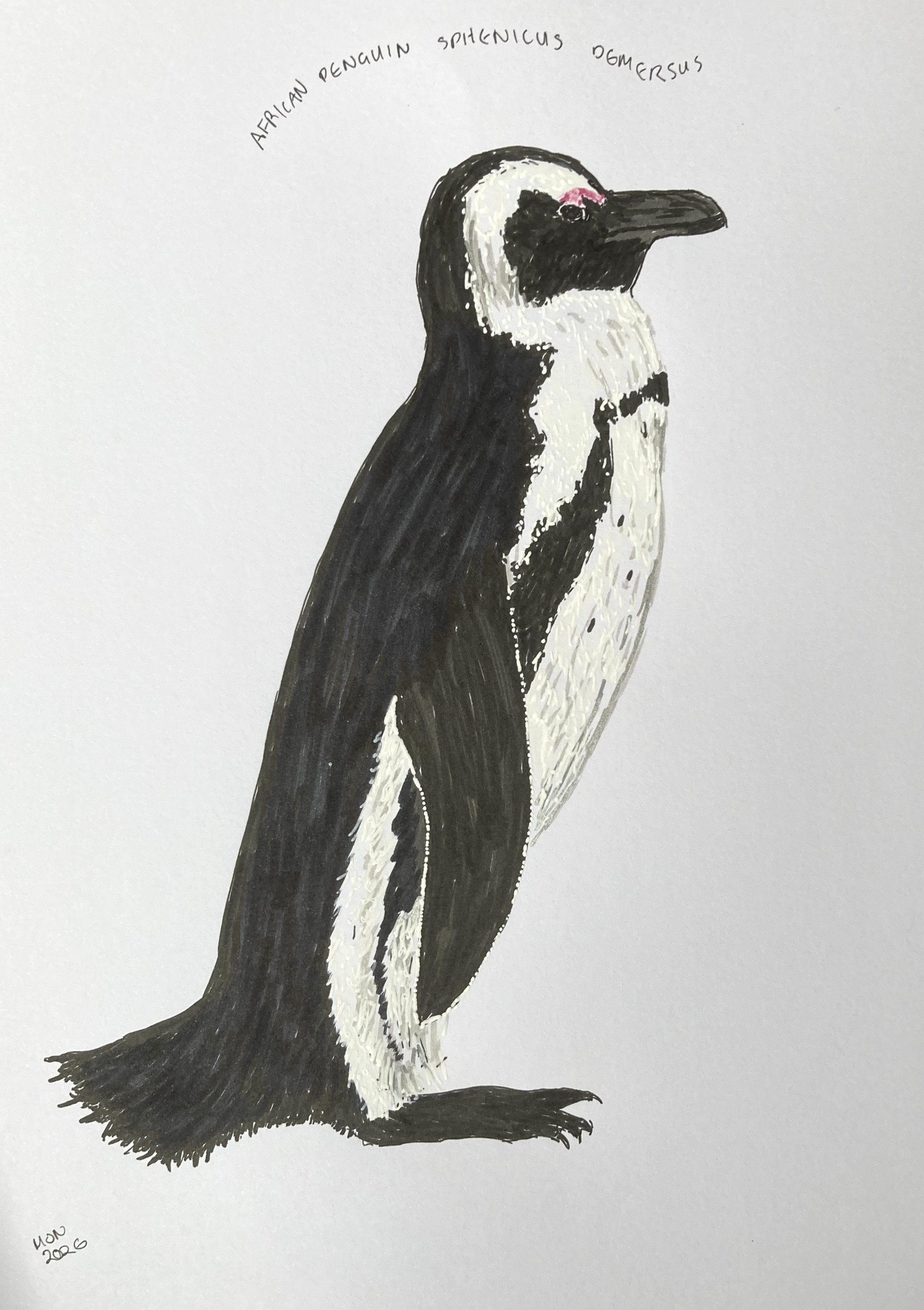
The African penguin declined because of many different human activities. In the early 20th century, over-harvest of eggs and disturbance caused by guano collecting were the main problems. These are now minor issues compared to industrial fishing, which meant a major decline in their food supply, oil pollution (both chronic, low-level pollution and major spills) and climate change, which is altering where the fish they feed on are found. So, by 2019, they were in no state to cope with further losses due to bird flu.
The 2019 outbreak killed more than 350 birds, mainly breeding adults. Nor had the other threats gone away. By 2023, the whole global population of this once-numerous bird was a little over 30,000, and more than 1000 had died from bird flu. In 2024, the African penguin was categorised as critically endangered.
Then, when the world had its attention on COVID-19, a new variant of bird flu emerged. The virus began to cause larger and more frequent outbreaks, including in wild birds. In Europe, it moved from causing sporadic outbreaks to being an established disease. It reached North America again, and this time it wouldn’t disappear.
The worst outbreaks in wild birds prior to 2021 typically killed thousands of birds at the most. The percentage of each species killed was usually tiny, a fraction of a percent. But the new outbreaks were much larger or affected a higher percentage of the population. Some killed more than 10,000 of a single species, such as an outbreak in Israel which killed 10,000 common cranes, and outbreak in Germany where several breeding colonies of terns lost more than 30% of their adult birds and an outbreak in the Solway Firth, on Britain’s west coast, which killed more than 11,000 barnacle geese, around 30% of the population from the area.
These losses were apparent at the population level for some bird species. The United Kingdom populations of great skua, northern gannet, sandwich tern and common tern all suffered obvious declines, particularly the great skua, which decreased by nearly 75% in the space of a couple of years. In Canada, more than 25,000 northern gannets were killed in 2022, estimated at around 12% of breeding adults. Around the Caspian Sea, tens of thousands of birds were killed, particularly Caspian terns. The Caspian Sea and the north-eastern coast of the USA were also among the first locations where bird flu was recorded spreading from birds to seals. They wouldn’t be the last.
Once bird flu was in North America, it spread south rapidly. By late 2022, it had reached Central America and the Caribbean, and as far south as Santiago, Chile, in South America. In 2023, it reached Patagonia, the Falkland Islands, South Georgia and the islands at the northern tip of the Antarctic Peninsula.
As in other parts of the world, large numbers of wild birds were killed, at least 667,000 from more than 80 species around South America in the first year following its arrival. The majority of these, more than 500,000, were reported in Peru. Once again, the majority of these were water birds, including species of cormorant, booby and swan. Tens of thousands of Peruvian pelicans, already under threat from industrial fishing and climate change, died in 2022 alone. Among the birds killed in large numbers were two species also native to New Zealand, sooty shearwater, known as tītī in New Zealand, and kelp gulls, which we call karoro or black-backed gulls.
As in Africa, the most endangered bird affected by bird flu in South America has been a penguin. The Humboldt penguin is related to the African penguin and, like its cousin, had suffered a precipitous decline long before bird flu arrived. There were once hundreds of thousands, but by 2017 only around 23,000 remained. It had long been a species which experienced fluctuations in numbers due to fluctuations in the availability of food due to El Niño and La Niña, and had previously recovered from the population falling as low as 5000. Nonetheless, it was a major blow in 2023 when 2100 were found dead along the Chilean coast. Although it’s not certain how many died from bird flu, this was more than 30 times the number of dead penguins found in an average year, and more than double the total number of dead birds from the previous 14 years.
In South America, the spread of bird flu to marine mammals accelerated. Seals and sea lions were the most often affected, but dolphins and porpoises were killed too. More than 52,000 marine mammals died within a year of bird flu arriving. In central Patagonia, where 17,000 southern elephant seals died in late 2023, bird flu was found to be spreading from seal to seal rather than seals becoming infected directly from sick birds. When bird flu reached South Georgia, it hit the elephant seals hard. Within a couple of years, the number of breeding females on the island had halved, a catastrophic loss when South Georgia is home to more than half of the global population. Earlier this year, the elephant seal was reclassified from a non-threatened species to vulnerable.
Also on South Georgia, bird flu killed gentoo penguin, snowy albatross and southern skua, the same species in which bird flu was detected in New Zealand. The numbers reported were low compared to some other birds, a few dozen of each, however because South Georgia is so remote these numbers are unlikely to reflect the real numbers of birds killed. On the South Shetland Islands, just north of the Antarctic Peninsula, bird flu was detected in six species of seabird, including shags, gulls, petrels and terns, as well fur seals and elephant seals. In 2024, bird flu was associated with unusually large numbers of dead skuas around the Antarctic Peninsula.
Bird flu has now reached some of the most remote islands in the world, such as Gough Island in the South Atlantic, and the Kerguelen and Crozet Islands in the southern Indian Ocean. So far, only a few dead skuas have been found on Gough Island, but dozens of dead birds and seals have been found on both the Kerguelen and Crozet Islands. On one of the Crozet Islands, there were around 150 sick or dead king penguins, although there were tens of thousands of healthy live birds still present. However, among the elephant seals, researchers estimated that more than half of the pups died.
One thing is obvious to me as I look through the publications about the spread in South America, Southern Ocean Islands and Antarctica: these outbreaks are too recent for us to fully understand the impacts. Large numbers of birds and marine mammals have died, from many different species. It’s horrifying, but it isn’t yet clear whether these deaths are endangering whole populations or species, rather than individual animals, apart from in a couple of cases. I’ve also come across articles where some species are recovering following the initial die-offs due to bird flu, such as barnacle geese in Solway Firth and great cormorants in the Baltic Sea.
I realise that to understand why some birds have proved more susceptible than others, it’s necessary to look more closely at which groups of birds have been affected and how the disease is spreading. To understand the risk to New Zealand, it’s also useful to consider which birds (and marine mammals) are most likely to become infected and which are least able to cope with a disease outbreak killing dozens or hundreds of birds. So, next week I will consider a few of the affected bird species overseas in more detail, then look at what that can tell us about the risk to our birds.
Fantastic review Mel. The best I’ve seen
This is a great resource for anyone interested in the ongoing threat from Bird Flu. I look forward to the next installment