

The booming business
Is the world's weirdest parrot clawing its way back from the edge of extinction? (11 minute read)

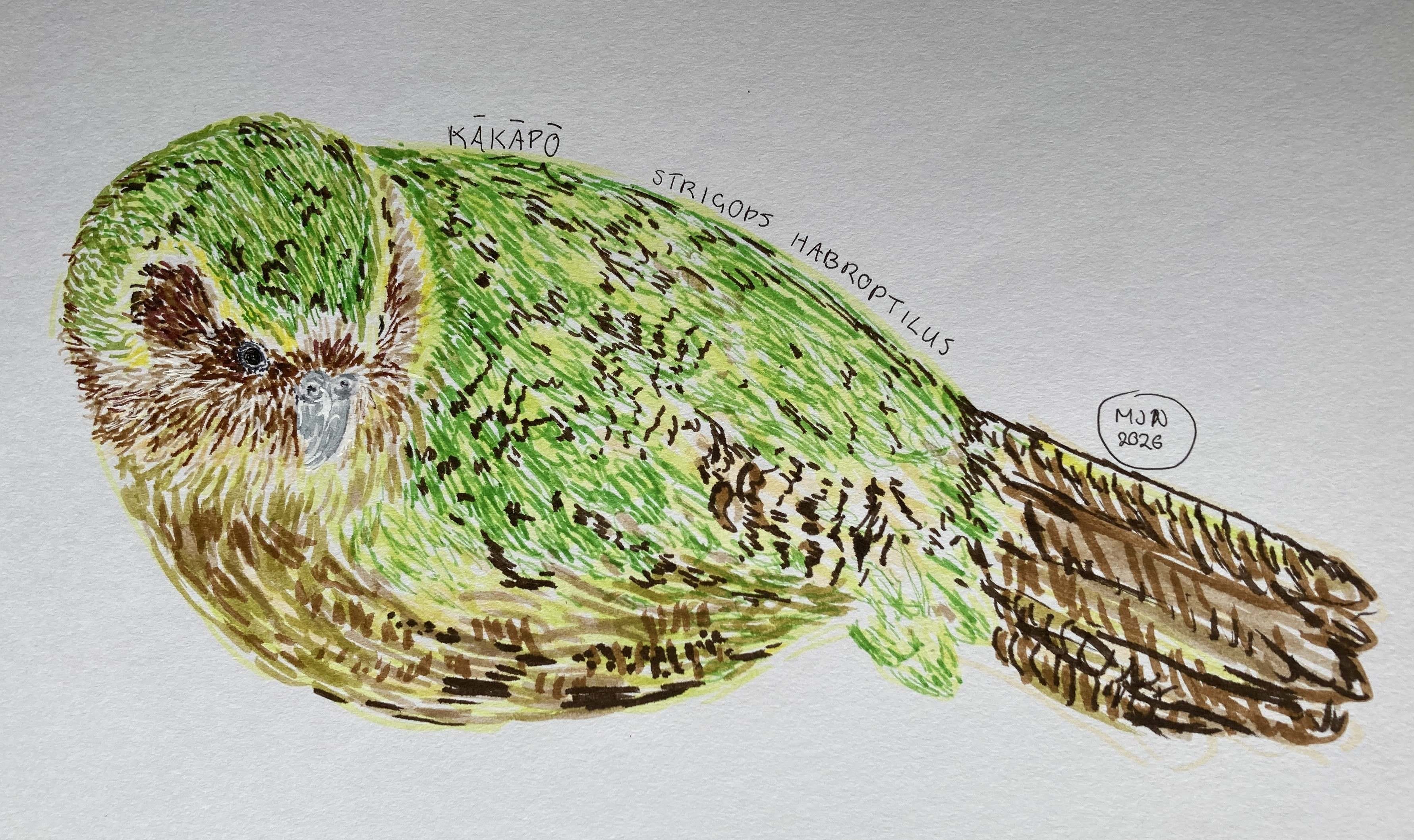
After a couple of weeks focused on killing invasive species, and with more to come, I wanted to take a moment to appreciate one of the species dependent on our predator-free island sanctuaries, the kākāpō. Right now, it’s an exciting time for those who care about New Zealand’s – and perhaps the world’s – weirdest parrot. For the first time since 2022, the kākāpō are breeding. After discovering the live Kākāpō Cam, which shows Rakiura on her nest, I’ve been checking in regularly. The last time I looked, Rakiura was asleep, looking as if she’s flopped face-first onto the ground then dropped off in that uncomfortable-looking position.
Why do I suggest that the kākāpō may be the world’s weirdest parrot? There are quite a few reasons, but let’s start with the obvious. On the whole, parrots fly around in the day, rather than stroll, scuttle, scramble and clamber about at night. As far as I know, there is one other nocturnal parrot, an Australian species called the night parrot, which looks remarkably like a kākāpō except that it’s around the size of a tūī. It’s not at all related, but it does share the dubious honour of being classed as critically endangered. It also shares the habit of spending most of its time on the ground, but it’s perfectly capable of flying. In fact, it’s been tracked flying up to 40 km in one night, whereas the kākāpō is the only flightless parrot. A large male can weigh up to 4 kg, and there’s no way it’s getting off the ground with its stumpy little wings.
The kākāpō, kākā and kea form a unique group apart from all other parrots, another reason that I consider the kākāpō weird, although in this case no weirder than the kākā and kea. Their ancestors split from other parrots as long as 82 million years ago, when dinosaurs still dominated the land, sea and sky. Despite going down some research rabbit holes, I haven’t been able to find what features distinguish New Zealand’s parrots from all others. There may not be anything obvious, since scientists have been debating what they are related to since their first discovery. Until the 1990s, they were thought to be related to Australia’s mini kākāpō. This is understandable, and not only because of the obvious similarities in habit and appearance. For more than a century Australia’s night parrot was thought to be extinct, making it difficult to study and make a detailed comparison. A single dead bird was found in 1990, and another in 2006, proving that the birds still existed, but no live birds were seen until 2013. It’s only with the use of genetic analysis, that we have a good understanding of the relationships between different parrot groups. It’s their genes, rather than any anatomical feature, which make our large parrots weird.
Another oddity is the kākāpō’s approach to finding a mate. Animals have many different strategies, but one of the weirdest is the lek. It’s like a pop-up nightclub, where males gather to show off their dancing and singing moves to attract females for a brief liaison. It’s found in many different kinds of animals, occurring in species of bat, antelope, fish and moth, among others, but it’s rare. One publication suggests that there may be 14 lek-breeding bats out of more than 1500 known species. It’s more common among birds, but among the parrots, there is only one.
In lek breeding, the males are typically within sight of one another, but sometimes, as in the case of the kākāpō, they are further apart, although still in earshot. Since the kākāpō is nocturnal, there’s not much point in the males shimmying, stamping and strutting like the grouse and bustards I’ve linked to here. Instead, they spend months creating the perfect booming bowl, a shallow depression in the ground surrounded by a network of tracks and additional bowls. Then, every night for months, they sit in their bowls and try to entice a female. Their siren song is a repeated low-pitched boom and a higher call known as chinging. The resonant booms, amplified by the bowls, can be heard hundreds of metres away.
Male kākāpō booming | Te Ara Encyclopedia of New Zealand
It’s a lot of work for a relatively brief encounter, on average, 39 minutes1. There’s no privacy when you are a critically endangered species. Then, the female flounces off to find another male or to nest alone. Crucially for such an endangered species, the females who mate with more than one male have a higher proportion of eggs which are fertile. Mating more than once with the same male also improves fertility, but not as much. So, in an effort to boost kākāpō numbers, conservation workers have been sneaking in to artificially inseminate the females.
The first artificial insemination attempts were made in 2009, resulting in five fertile eggs, but it took some years for the feat to be repeated. However, in the 2019 breeding season, four chicks resulting from artificial insemination were born, including two from males who hadn’t previously bred. One of these was a male called Sinbad, son of Richard Henry, the sole survivor of the birds which clung to survival in a remote Fiordland valley until the 1970s. Richard Henry finally bred late in his life, producing one female and two male chicks which carried the last of the mainland kākāpō genes. But Sinbad was mostly hand-reared, which means he’s rather more attached to humans, and less interested in other kākāpō, than he should be. With artificial insemination, however, he has managed to pass on his valuable genes.
While I’m on the subject of dysfunctional hand-reared kākāpō, I must mention one of the weirdest events in television history. It starred Sirocco the kākāpō, zoologist Mark Carwardine and Stephen Fry. In 2009, Carwardine and Fry were visiting New Zealand to film part of a BBC documentary on endangered species. They were introduced to Sirocco, another hand-reared bird, who took something of a shine to Carwardine. The footage of Sirocco on Carwardine’s head attempting to mate, while Stephen Fry laughs hysterically off-camera, has been viewed on Youtube more than 30 million times. Carwardine wasn’t laughing though, because kākāpō have sharp, powerful claws and Sirocco had a firm grip on him.
As far as I can tell, kākāpō are no longer hand-reared, at least not unless it’s absolutely unavoidable. As Sirocco and Sinbad have demonstrated, it’s not in the best interests of their long-term survival as a species. Instead, conservationists have experimented with other approaches to improving egg and chick survival.
The male makes no contribution to their care, so the female leaves her eggs and chicks alone when she goes to find food. This is a dangerous time, leaving the eggs and chicks vulnerable to the cold or other birds which enter the burrow. Some years ago, I remember one of the rangers who worked with kākāpō telling me about their strategy at the time. The rangers, along with a crew of hardy volunteers, used to wait, out of sight, near the nests, which are in burrows among tree roots. When the female left, they brought out a pole with a warming pad on one end, which could be held over the egg or chick to keep it warm. When the female was returning, they’d quickly remove the warming pad and scurry out of sight so she’d never know they’d been there.


The process has moved on since then. In the 2019 breeding season, the eggs were checked when the females are off the nest, and the fertile ones removed to incubators until they were close to hatching. In some cases, the females were given dummy eggs, but in other cases all the eggs were removed to encourage the birds to lay more. The eggs were returned to a nest – not necessarily the nest they came from – just prior to hatching. However, there was a problem. For a while before hatching, the chicks inside their eggs make sounds which tell the mothers to prepare. The dummy eggs weren’t doing this, and the chicks were emerging to an unprepared mother. The solution has been to use smart eggs, which emit chick-like sounds to let the mothers know of the imminent hatching.
In the 1970s, this wonderfully weird bird was thought to be all but extinct, as there were only 15 birds known, all male. Hope came when more birds were found on Rakiura (Stewart Island) in 1977, but they were in desperate trouble. Initially, there were 85 birds found alive, but within a few years 13 had been found dead and 11 could not be located again. The remains of the dead birds indicated that feral cats were probably the culprit in most cases. The surviving birds were relocated to islands free from most predators, although there were still kiore on some of the islands.
By 1995, there had been 61 kākāpō rescued from Rakiura and one from Fiordland, but some had died and there had been few chicks surviving to adulthood. That was the low point for the kākāpō, with only 51 remaining. The birds faced several problems, including infrequent breeding, low fertility and kiore predation of chicks. Intensive management slowly began to make a difference, but real progress came with the eradication of introduced mammals from islands with extensive rimu forest. Scientists had been aware for some years that kākāpō breeding was synchronised with mass fruiting of certain trees, particularly rimu2. But it was only with the development of better eradication tools that they could give the birds what they needed.
Since the concerted efforts to save the kākāpō began, they have become remarkably well-travelled for a flightless bird. At times, there have been birds on Te Hauturu-o-Toi (Little Barrier), Mana Island (near Wellington), Te Pākeka/ Maud Island and Nukuwaiata in the Marlborough Sounds, Pukenui (Anchor), Te Kākahu (Chalky) and Coal Islands in Fiordland, and Whenua Hou (Codfish) and Pearl Islands near Rakiura. Partly, this jet-setting has resulted from the need to eradicate kiore from some of the islands, because a curious kākāpō is the last thing you’d want hanging around during a toxic bait drop. Partly, it’s been an attempt to mix up the males and females to avoid inbreeding. Some of it has been pragmatic, as an island like Te Pākeka has much easier terrain than Te Hauturu-o-Toi. And some of it has been an attempt to find out where they do best.
Now, though, most of the kākāpō are on just three islands, Whenua Hou, Pukenui and Te Kākahu, all with plenty of rimu trees. A few males are also on Coal Island and at Maungatautari, a fenced sanctuary south of Hamilton. Official figures say that there are 236 birds, which is still a dangerously small number but there are now more kākāpō than there are tara iti (fairy tern), kaki (black stilt) and tuturūatu (shore plover). It’s time for a change of direction in saving kākāpō.
In 2022, the birds on Te Kākahu hatched three chicks with less intensive management than is used on the other two islands. This season, these less intensive approaches are being used for some of the kākāpō on Whenua Hou and Pukenui as well. More eggs are being left to be incubated naturally, and there is less checking of the nests, except for some of the highest priority birds which carry particularly important genes. Some of the chicks born this year will not be named, in recognition that these are wild birds, not zoo animals.
But for the kākāpō to truly thrive, there’s one thing that they need more than anything else – more room. The predator-free islands with suitable forest have almost all the kākāpō they can support. Years of innovation and intensive management have done what they needed to do, but now we need more of New Zealand conservation’s cornerstone – removing species which don’t belong here. Only if predatory mammals can be eradicated from extensive areas, such as Rakiura, will there be enough suitable forest for these magnificently weird birds.
Although some females do mate more than once with the same male.
It’s likely that there is matauranga Māori recognising this too.
Great summary of the perilous last 60-70 years of kākāpō history. I love watching Rakiura Live Cam. I normally scroll back to see the (now) two chicks, left by themselves while Rakiura feeds. It is fascinating to see them growing and to watch her feed them when she returns. They are a weird species! But loveable.
👍 Excellent summary & cool drawings 🤔 For those heading over to the live channel, if you click on the "Department of Conservation" words underneath, you can see some highlight clips, particuarly interesting when a Ranger comes to check the chicks while Rakiura is absent, when they explain what they are doing & bonus is when their headlamps make the feed into colour instead of the gray-scale we get with the infrared that is normal on this feed 🥳 I generally have at least 2 or 3 live feeds of birds going, but this "weird parrot" is particularly engaging, not least because I MAY have seen her on a visit to Whenua Hou in the past - some resident Kakapo wandered up around the HQ & I like to imagine she was one of them 😂