

Unintended consequences
Complexities and controversies in invasive species (12 minute read)

Over the years, I’ve learned many lessons from my gardens. I first learned to observe the natural world in a garden. I learned to practise patience waiting for seeds to sprout, flowers to bloom and fruit to ripen. As I’ve mentioned previously, gardening taught me where food comes from.
One crucial lesson, something I learned when I was still a child, is that growing a garden is not the same as building something from inanimate materials. My brother and I had a couple of Lego sets as children, and the experience of building with Lego was entirely different from gardening. There were certain constraints with Lego, governed by the bricks we had and how they could be configured. However, within those constraints we had complete control.
A garden is entirely different. It is comprised of living things, not all of which will behave as we hope or expect. Some plants may not appreciate the conditions and fail to grow. Others may grow better than anticipated and swamp their neighbours. Plants which were already there don’t simply disappear because we want something else growing in the space. Some turn up of their own accord, carried by the wind, by birds, or brought in with soil or mulch. At times, these are a pleasant surprise, but more often than not they are something we consider a weed.
It isn’t only the plants which don’t cooperate with our plans. Insects and snails feast on our carefully tended treasures. Fungi blacken leaves and rot fruit. Blackbirds uproot seedlings and eat our berries before we can. Sometimes we need to contend with possums, rats and rabbits. And then there’s the weather – too much rain, too little rain, wind which buffets blossoms and knocks branches from trees, unseasonal frosts which strike soft spring shoots.
From gardening, I learned a kind of humility towards nature. We have a degree of control by choosing the right plants, by weeding, watering, feeding, pruning and spraying. But we can’t bend nature entirely to our will.
At the same time as I was learning to garden, I was learning about New Zealand’s extinct and endangered species. I remember Auckland Museums dioramas of giant moa, cases of stuffed huia and kākāpō, and pinned specimens of giant wētā. I watched television documentaries about the desperate, sometimes unsuccessful, fight to save birds which only survived on the remotest offshore islands. I learned that many birds and insects survived on these remote offshore islands only because these islands were free from introduced mammals, most of which had been brought to New Zealand deliberately. Those who had brought possums, stoats and other mammals to New Zealand hadn’t intended or expected them to drive native species to extinction, but that was what happened. Once again, I was led to the realisation that nature won’t always behave as we want or expect it to.
I maintained an interest in both gardening and conservation throughout my school years and into university. However, apart from growing a few native plants and coning across common native insects in my garden, they were separate interests. Then, one day, I was working on a project which involved studying the plants in a local reserve. I found a shrub growing there which I couldn’t identify. I was sure it was native, because it was throughout the bush, under an established canopy of ancient pūriri trees. But despite looking through several books and guides, I couldn’t figure it out.
The curious plant was in the back of my mind, nagging at me, for days, until I had a sudden insight. I looked out the window at a shrub with glossy green and yellow leaves. If I looked carefully at the leaf shape and arrangement, I could see that the green and yellow shrub was the same as my mystery shrub from the reserve. The only difference was that the wild plants had lost the ornamental coloration of the garden plants. From there, I went straight to a book on gardening and found the name Japanese spindle tree.
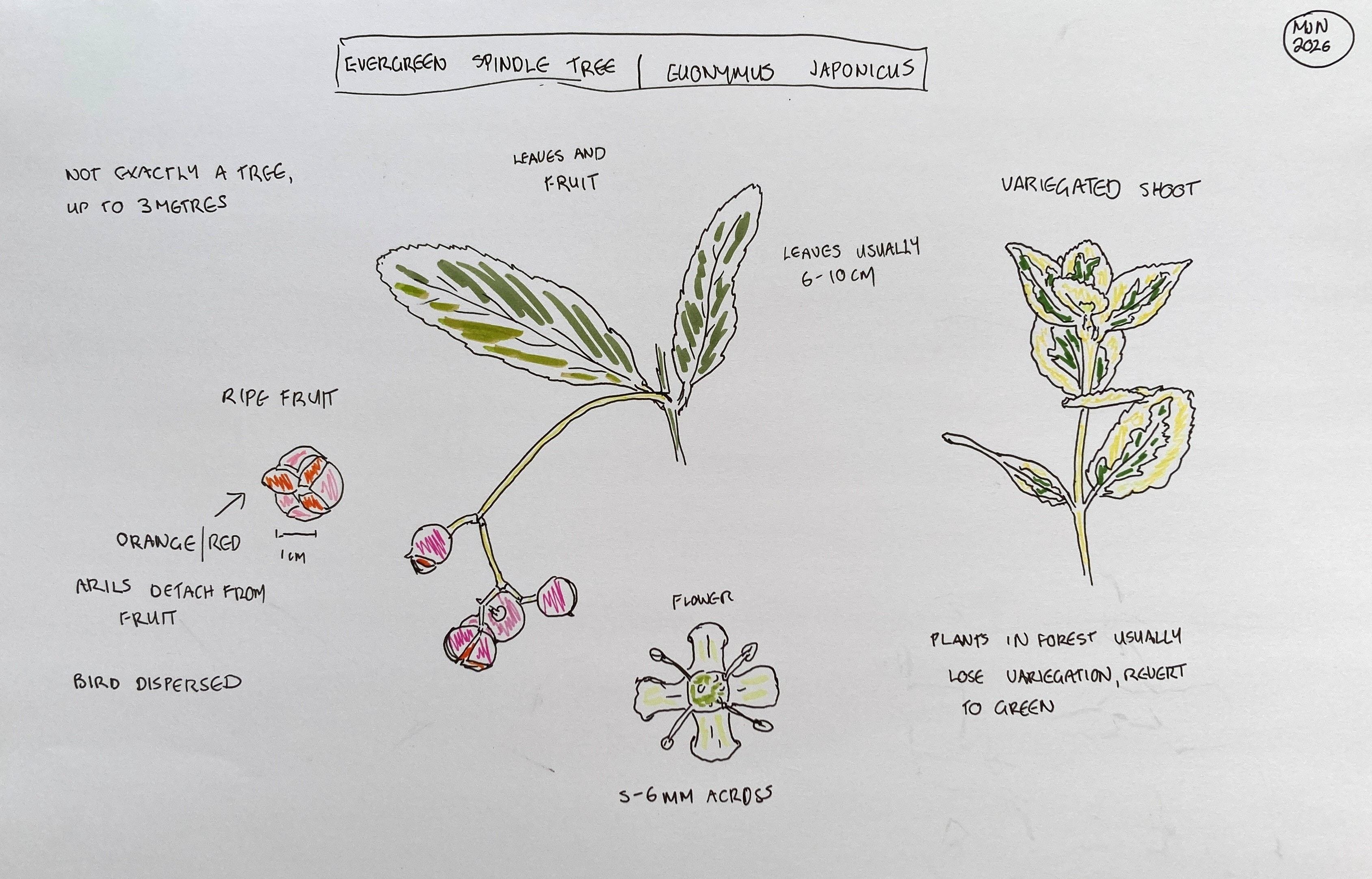
My house was far enough from the reserve that our garden probably wasn’t the source. However, my discovery established a connection in my mind between the choices I made as a gardener and what happens in our native forests and other wild areas. I could look back on the introduction of stoats or possums and understand that it was a different time1. But, I realised, people were still spreading invasive species. When I looked at some of the plants I’d grown, I realised that I had contributed to the problem myself.
Invasive species are on my mind at the moment, because next week I’m in Auckland attending a conference about invasive species on islands. It’s a periodic conference first held in 2002, and I attended it then and also in 2011. I’m looking forward to hearing about the remarkable progress we have made since the first conference, as well as the new invasive species problems which have arisen. I’m sure that there will be many interesting talks, and that I’ll have a number of topics I want to write about as a result.
I write about invasive species reasonably often and it’s an issue familiar to many people interested in nature, particularly in New Zealand. However, the science of invasive species is anchored in certain assumptions and beliefs which are not always apparent. There are concepts which work in somewhere like New Zealand, which don’t work in places such as Europe, or even Australia. At times, even scientists working on the issue can’t agree on basic questions, and those who are involved in the practical side of managing invasive species sometimes see things differently again.
There are some real complexities to the issue, so I thought I’d look at these before I write about what I learn at the conference. There are also some important questions about the language we use to describe invasive species, and how this affects our ability to communicate about them in a way which doesn’t have unintended impacts.
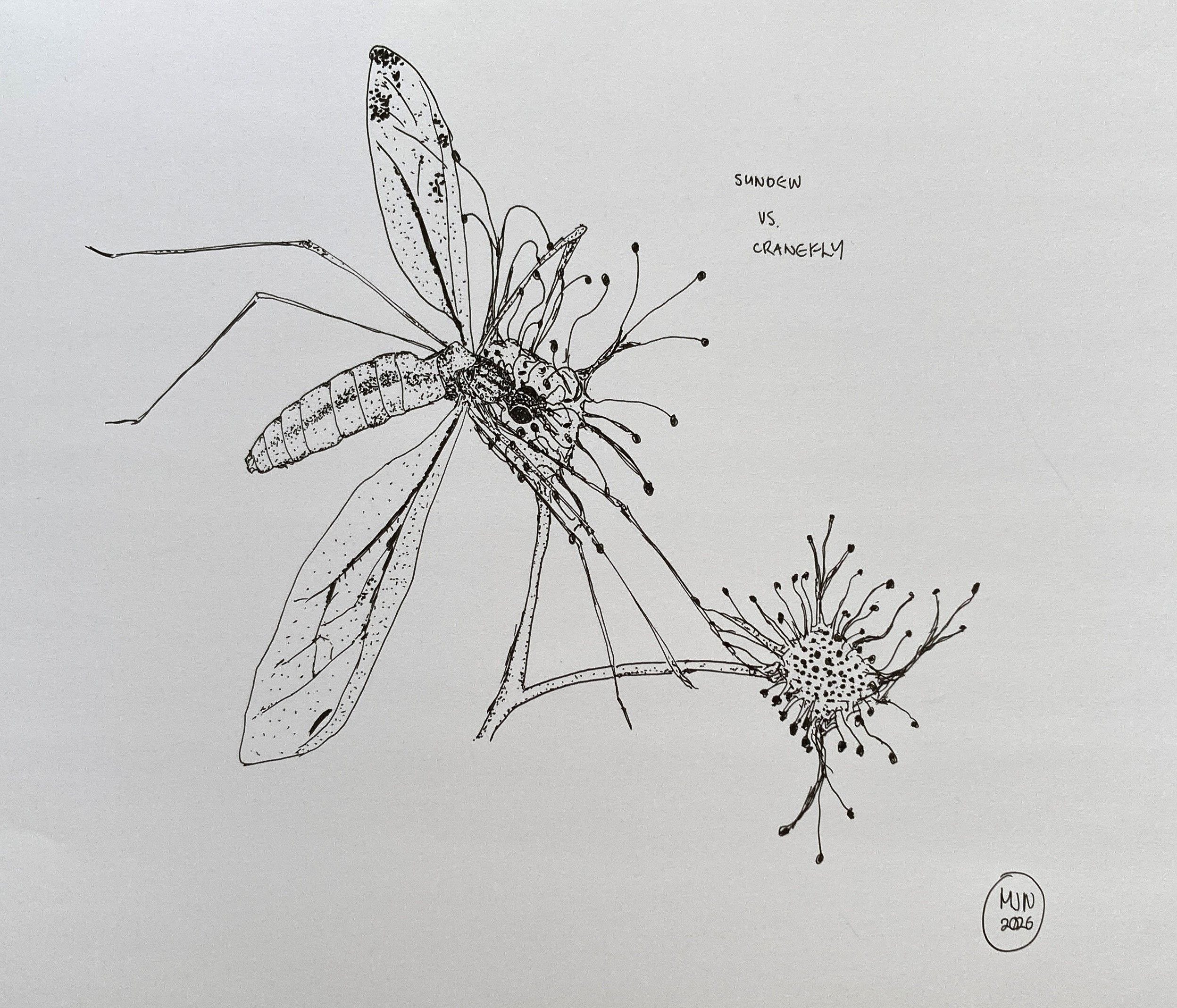
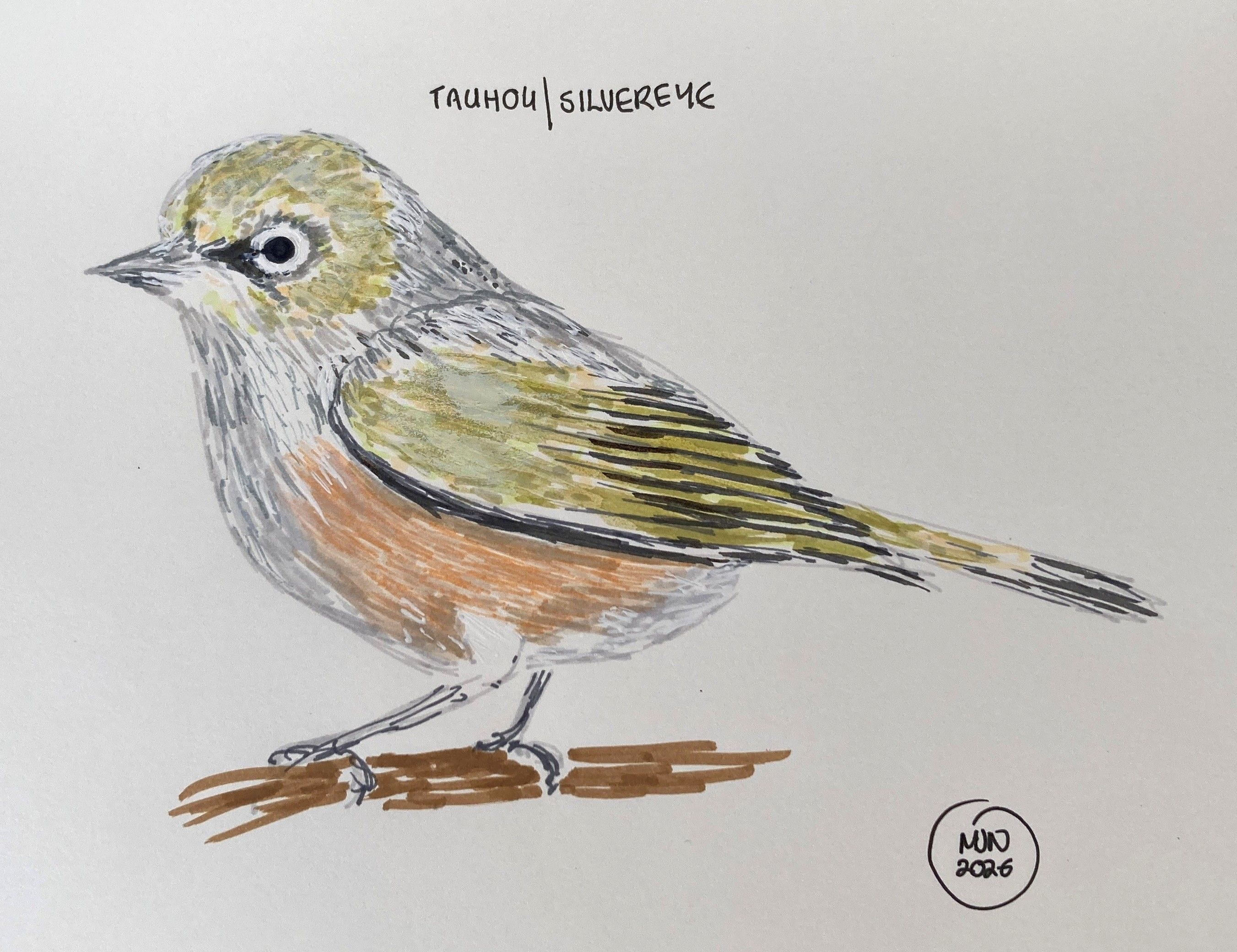
The first complexity with invasive species is that scientists don’t agree on what they actually are. There’s general agreement that to be considered invasive, a species must not be a native species, but this begs the question of what is, and isn’t, native? In New Zealand, we define non-native species as those which were brought here by humans. Most of our native species evolved here, but we consider any species which arrives here without human assistance to be native. The tauhou or silvereye, a small bird which first arrived in New Zealand in the 1850s, is considered native, because it arrived from Australia without human assistance. A more recent example is a kind of sundew which arrived in New Zealand from Australia in the late 20th century.
But New Zealand is an island, and it usually isn’t difficult to work out which species were brought here by humans and which were not. We are also comparatively small. We do have species which are native only to specific areas and are considered non-native elsewhere, but very few of them crop up in discussions about invasive species2. Australia, however, is another story. It’s a massive, diverse country with almost every kind of climate from tropical rainforest to snowy alpine areas. Just because something is native to one part of Australia, that doesn’t make it sensible to consider it native throughout the country. Somewhere like Europe or Africa is another matter again. Borders between countries are political and of little value in understanding native plants and animals. Australia, Europe and Africa have also had human influences on the continents for much longer than New Zealand.
To make sense of what is native and what is not, scientists define arbitrary boundaries. In Europe, there’s a distinction between species introduced before and after the year 1500. In fact, a recent European publication defined ten different categories of native and non-native species, to account for how long species have been present, how they arrived and how they are perceived. In Australia, the term native is often applied to species which occur naturally anywhere in Australia, with the term indigenous applied to specific areas. The red-flowering gum, currently looking spectacular around Wellington, is defined as an Australian native which is indigenous to a small area in the south-west of Western Australia.
Does this mean that a native species can be defined as invasive if it’s well outside the area where it originally grew? In some cases, yes, but it depends on the definition of invasive, which is another problem, because there are two definitions in widespread use. The definition favoured by many scientists is based on the ability of a non-native species to spread far from where it was introduced. Those whose role is more in policy or management mostly tend to favour a definition based on the ability of a non-native species to cause harm.
Both definitions have merit. It’s possible to measure the spread of a species objectively. While it is possible to objectively measure the impact one species has on other species, it’s more difficult than measuring spread. Harm is even more difficult to measure, because it is subjective. I may think it’s terrible that blackberry is replacing native sedges in the wetland at my local reserve, but others won’t care. The subjective nature of harm may suggest that it’s best to use the spread-based definition. If the goal is simply to observe and understand the movement of species, then that approach makes sense. However, when it comes to making decisions about management, then it’s the harm which matters, not simply the spread. This is why I favour the definition based on harm, and when I write about invasive species, I am using that definition.
One of my favourite examples of a species which would be considered invasive by one definition but not the other is a small yellow daisy called wall lettuce. It’s one of the most widespread of non-native plants in New Zealand, frequently found deep in the forest and in remote areas. It would be considered invasive using the spread-based definition of the word, but not the impact-based definition. I’ve never heard of it being controlled, nor have I ever pulled it out myself. It might grow in remote areas, but there’s never very much of it, and to my knowledge it’s never considered harmful.
One way of getting around the confusion in definitions is to use the term harmful invasive species, to distinguish those which are having a negative impact from those such as wall lettuce, which probably aren’t. However, there’s another point which needs to be considered. It’s a central assumption about invasive species, but it’s often forgotten.
The concept of an invasive species only makes sense if we make value judgements about different species. It’s based on the central idea that it’s important to protect species from extinction, and that we should do so in the places where they naturally occur, or where they occurred prior to human influence on the environment. There are compelling reasons in support of this idea, although I won’t go into detail here. For me, among the most compelling is that it isn’t always possible to predict the effects when we alter the combination of species in an area. However, the central idea is a matter of value and not a scientific fact.
I’m stating the obvious when I say that I believe in this central idea. It is very much a part of my values and what I think is important. But different views and competing values need to be considered as well. Invasive species management, for example, often collides with animal welfare considerations. In New Zealand, decisions on controlling invasive mammals such as stoats and rats need to consider the humaneness of the control methods as well as their effectiveness.
There’s another aspect of invasive species which often gets overlooked, but which needs to be recognised. The language used has emotional connotations which may not be intended but are certainly noticed by some people. Even if an invasive species is defined solely by its ability to spread, the term invasive itself implies that it is something harmful. There’s a lot of war-related imagery in the language of invasive species. It’s common to hear references to fighting or battling invaders, for example.
The language also implies xenophobia, with the focus on protecting native from non-native species. Critics often suggest that encouraging native species and controlling invasive species is xenophobic, or at least aggressively nationalistic. On the whole, these criticisms are based on a false assumption that those who study and manage invasive species consider all non-native species to be harmful. There is, however, a need for caution in the language used, especially at a time when politicians and governments are increasingly targeting immigrants and refugees. The issue of invasive species should in no way be conflated with human migration.
There are suggestions that it would be useful to change much of the language around non-native and invasive species to be more neutral. This idea has been around for a while, but there seems to be increasing interest in recent years. Some species have had name changes, in particular those where the common name refers to an ethnic group. The most obvious example is the spongy moth3. Most organisations are now using this common name, a translation of the French common name and a reference to the texture of the eggs.4
There are also efforts to remove names of countries from common names of invasive species. This is a step further that removing offensive terms, and at first I was unsure whether it was necessary. It doesn’t bother me, for example, that an invasive plant on St Helena island is called New Zealand flax5. However, New Zealanders have never had any reason to feel under threat from the people of St Helena. At the start of the COVID-19 pandemic, when Asian communities were subject to increasing racism and stigmatisation, it’s understandable that discussions about eradicating Chinese privet or Japanese spindle tree might be disturbing. If we want to distance ourselves from the actions of those who are victimising those from particular countries or ethnic groups, then avoiding such names is one way to do so. INaturalist has helpfully offered me the alternative common name of evergreen spindle tree for the plant I found in the forest all those years ago, so evergreen spindle tree it is.
Whether those who work in conservation and managing invasive species will go further, and use alternatives to words such as native or invasive, is another matter. Some proposed alternatives, such as locally evolved and neobiota instead of native and non-native, can be wordy and opaque. I will make an effort to avoid names which reference ethnicity or country. At this stage, I’ll continue to use terms such as native and invasive until there’s more clarity and agreement on terminology. I will be keeping an eye on what is happening, though, because there are changes coming. As someone who has worked in this field for decades, I may have blind spots in how the terminology comes across to those who haven’t.
Although it was certainly a different time, this is not to say that they weren’t warned that the introductions were a bad idea. There were certainly those who predicted that mustelids (stoats, ferrets and weasels) would be harmful. However, those who wanted to introduce those species ignored credible evidence and advice.
I will return to this topic, as I’ve got a couple of related articles planned.
The former name was a term coined by the English to describe the Roma, but it is considered offensive by most Romani communities.
There is a wider move within the botanical community to change names which are particularly offensive, such as the term caffra. Around 300 plants and fungi which formerly had this word as part of their name now contain affra, or similar words meaning from Africa, instead. Zoologists, however, argue that to do so would be a threat to scientific communication. The name changes probably will cause some confusion, but then so do changes made because of new scientific knowledge, and we manage to cope with that.
Yes, our native harakeke or flax really is a problem there, and it’s also a problem on some Hawai’ian islands.
When I teach interns about nonnative species, I tell them it's just as much about philosophy as it is about biology. I will point to eucalypti, trees brought from thousands of miles away to Southern California and ask if they are nonnative. Everyone agrees that they are.
But I will point to Saint Catharine's lace, a buckwheat endemic to an island 30 miles off our coast and ask if that is nonnative. I do the same with Tecate cypress, trees planted in our landscaping but otherwise native to mountaintops about 20 miles distant. With these examples, the answers start to get fuzzy.
Thanks for the reminder of the link between plant choices in my home garden and what happens in our native forests.